
Introduction
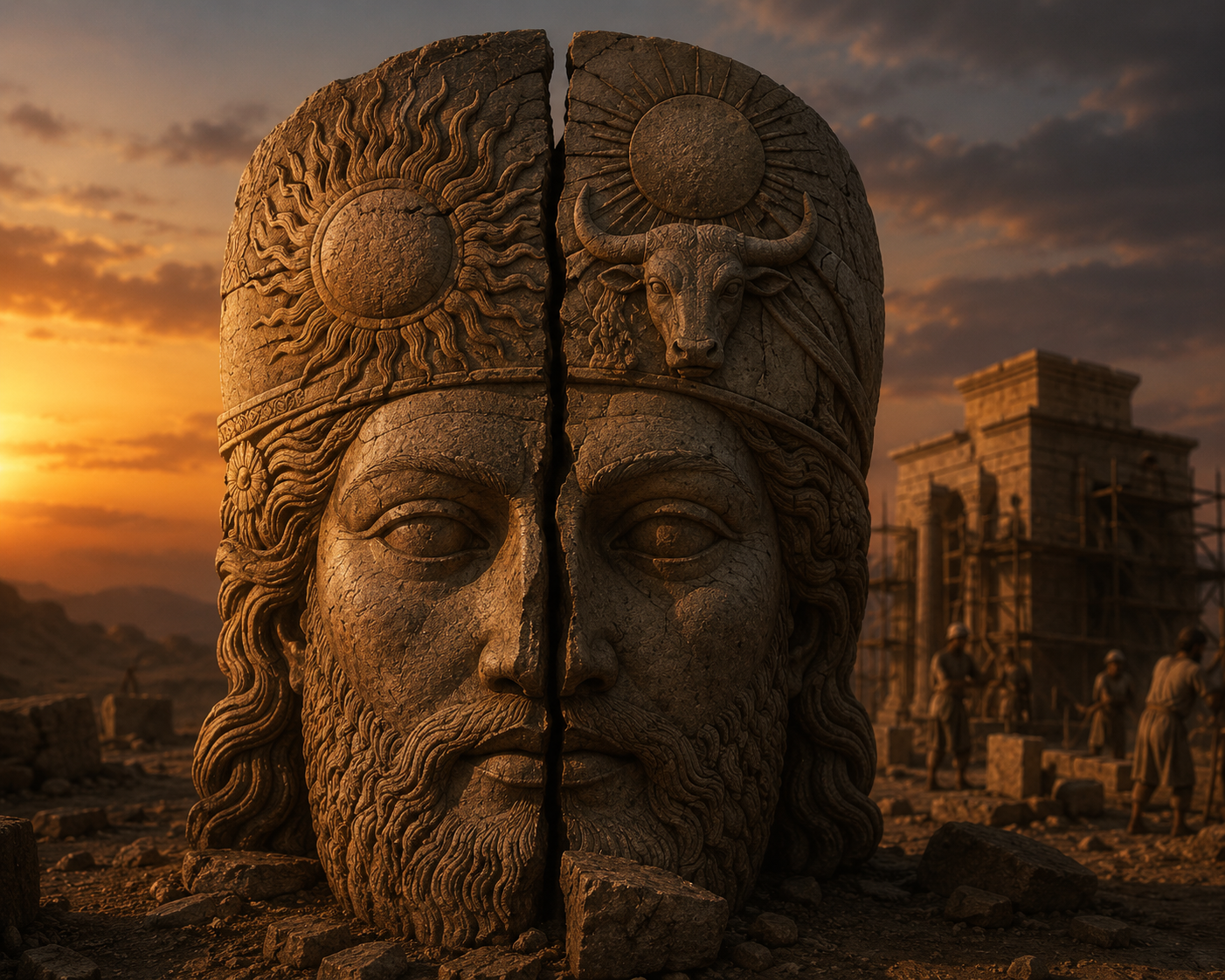
The historiography of ancient Iranian religion has long operated under an implicit convention: whatever cannot be securely assigned to another tradition is folded, by default, into “Zoroastrianism.” Richard Foltz has argued, across several publications, that this convention is not a neutral simplification but a systematic distortion — one that erases a distinct and, in certain periods and regions, dominant religious current centered on the god Mithra. This essay defends Foltz’s position in its strong and specific form: that Mithra-worship in the pre-Sasanian Iranian world constituted an independent religious tendency, coextensive with rather than subordinate to Mazda-worship, and that its subsumption under a retrospectively constructed Zoroastrian orthodoxy is a category error produced by uncritical backward projection from Sasanian and later sources.
The Problem of Backward Projection
Foltz’s argument begins from a methodological observation with implications well beyond the Mithra question specifically: modern scholarship inherited its basic taxonomy of Iranian religion from nineteenth- and twentieth-century Zoroastrian studies, in which a canonical, text-centered “orthodoxy” served as the measuring stick against which everything else was classified as deviation.1 Applied to the pre-Sasanian period, this produces an anachronism. The codified, priestly-supervised form of Mazda-worship that later ages would call Zoroastrianism did not achieve anything like institutional dominance until the political program of the early Sasanians, executed with the backing of ambitious clerics such as Kerdir.2 To read that later consolidation back into the Achaemenid or Parthian periods — treating every trace of Iranian religiosity in those centuries as a variant expression of a Mazdaean core — reverses the actual historical sequence. Foltz’s corrective is not merely terminological. It reopens the question of what pre-Sasanian Iranian societies actually believed and practiced, unconstrained by a taxonomy built for a later age.
Evidence for an Independent Mithraic Tendency
The case for Mithra’s independent status rests on a convergent body of evidence spanning nearly two millennia and multiple regions, which Foltz assembles rather than merely asserts.
Indo-Iranian antiquity. Mithra’s credentials as an ancient and autonomous deity — rather than a later accretion to a Mazdaean system — are established by his appearance, alongside Varuna, Indra, and the Nasatyas, in the fourteenth-century BCE treaty between the Mitanni king Kurtiwaza and the Hittite Shuppiluliuma I.3 This places a fully formed cult of Mithra centuries before any securely dateable evidence for a specifically Zoroastrian religious program, undermining any account in which Mithra enters Iranian religious life merely as a satellite of Mazda.
Achaemenid-period distribution. Foltz notes that the evidentiary picture for the Achaemenid period is considerably more complicated than the standard narrative of dynastic Mazda-worship allows. Aramaic administrative tablets from Persepolis dating to the reign of Darius I record a higher volume of ritual donations to Mithra than to Mazda.4 Cyrus the Great’s tomb bears solar iconography with plausible Mithraic associations, and later Achaemenid rulers — Artaxerxes II and III among them — invoke Mithra and Anahita alongside Mazda in royal inscriptions, a pattern generally read as acknowledgment of three co-equal major cults rather than one dominant tradition with two minor satellites.5 Geographically, Foltz observes a further asymmetry: Mazda-worship is best attested in western Iran, while Mithra appears to have held greater prominence further east — a distributional pattern with direct bearing on any argument, such as one concerning the Khorasan corridor, that treats the eastern Iranian world as a distinct religious zone.6
The Parthian evidence. The strongest documentary support for Mithra’s independent, and at times possibly dominant, status comes from the Arsacid period. No fewer than four Parthian kings bore the theophoric name Mithradates, and the easternmost of the three great sacred fires later canonized under the Sasanians, Burzin-Mehr, most likely originated under Parthian rule.7 Foltz gives serious, if appropriately qualified, attention to Parvaneh Pourshariati’s argument that leading Parthian noble houses — the Karen and the Mehran, whose very name Foltz glosses as signaling Mithraist identity — retained a religious allegiance in tension with Sasanian Mazdaism throughout the imperial period, a tension that surfaces explicitly in the late sixth-century revolt of Bahram Chobin, remembered in Armenian sources under a name meaning “servant of Mithra,” whose power base was centered on the Mithra fire in the east rather than the Mazdaean fires of the Sasanian west.8 Foltz further notes the semantic evidence: it is in Parthian, not in Avestan or Old Persian, that Mithra’s name first becomes the ordinary word for “sun” — a linguistic development that Ilya Gershevitch connects to Manichaean theology, in which Mithra was identified with the divine emissary said to dwell within the sun.9 Foltz treats this shift, together with the wider Parthian and Sogdian reception of Manichaeism’s elevation of Mithra over Mazda, as further evidence that eastern Iranian populations may have held a preference for Mithra that the Mazdaean textual tradition subsequently obscured.
Bactria and the Kushan realm. Numismatic evidence from Kushan Bactria shows Mithra as the most frequently depicted male deity, identified iconographically with the Greek Helios and, in some issues, occupying the position elsewhere held by Zeus.10 Foltz’s treatment of this material is where his critique of the historiographical default becomes most pointed: scholars of the stature of Mary Boyce, Nicholas Sims-Williams, and Frantz Grenet have read this numismatic dominance as evidence for a so-called “Bactrian Zoroastrianism.” Foltz rejects this classification as a category error, offering the deliberately provocative analogy that describing a Mithra-dominant religious culture as a variety of Zoroastrianism is comparable to describing prominent Ba’al-worship as a variety of Judaism.11 The analogy is polemical, but the underlying point is methodologically serious: when the numismatic and onomastic evidence for one deity substantially outweighs that for another, classifying the whole religious culture under the minority deity’s later institutional name is not conservative scholarship but an interpretive imposition.
Distinguishing the Iranian and Roman Cults
A further strength of Foltz’s argument, and one worth defending explicitly, is his refusal to collapse Iranian Mithra-worship into Roman Mithraism, or vice versa. He treats the Roman mystery cult — with its exclusively male initiatory grades, its tauroctony iconography, and its concentration in military contexts across the empire — as a genuinely disputed case, fairly representing the range of scholarly opinion from Franz Cumont’s assumption of substantial Iranian continuity to Stig Wikander’s view that only the god’s name survived the journey westward, with the remainder of Roman Mithraic practice being a Mediterranean invention.12 Foltz does not adjudicate this dispute; he notes, following John Hinnells and Bruce Lincoln, evidence that favors a degree of continuity — the moon-and-bull cosmology, the solar-savior role attested in the Avestan Mehr Yasht’s language of Mithra assisting the soul’s ascent, and details in temple iconography that Hinnells reads as archaic Iranian survivals reinterpreted for a Greco-Roman audience — while conceding that the evidentiary base is too thin to settle the matter definitively.13 This is the correct scholarly posture, and it matters for the wider argument: the case for Mithra’s independent status in the Iranian homeland does not depend on, and should not be conflated with, claims about the god’s status in the Roman army four centuries later. Keeping these two bodies of evidence analytically separate is precisely what allows the Iranian case to be evaluated on its own considerably stronger footing.
Rural Survival and Later Continuity
Foltz’s account extends the argument diachronically by tracing what he, following Mehrdad Bahar, treats as rural survivals of Mithraic practice into the Islamic period.14 The bull sacrifice — abhorred in both the Vedic and Zoroastrian textual traditions but persistent among Western Iranian rural populations — is read as a substrate practice absorbed from pre-Iranian Mesopotamian and Elamite populations and subsequently attached to Mithra precisely because of his association with justice, a quality valued by populations without formal recourse to state power.15 Foltz connects this rural substrate to the bull sacrifice rituals preserved among the Kurdish Yezidi and Yaresan (Ahl-e Haqq) communities, and — more cautiously — to the ethical codes of the traditional Iranian gymnasia (zurkhaneh) and their practitioners (pahlavanan).16 He is notably more skeptical of Hassan Pirouzdjou’s attempt to trace a continuous Mithraist inspiration through the Mazdakite movement, the Sarbedar rebellion, the Horufiyya, and the Qizilbash, characterizing this genealogy as “somewhat overextended” even while allowing that some of the specific parallels Pirouzdjou identifies — such as between the tauroctony and a ninth-century Khurramite sacrificial rite — merit attention.17 This calibrated skepticism is itself a model worth defending: it shows that accepting the core thesis (Mithra as an independent tradition with rural staying power) does not commit one to accepting every downstream claim of Mithraic influence advanced in its name.
Why the Distinction Matters
The significance of Foltz’s argument is not antiquarian. If Mithra-worship functioned as a genuinely independent tradition — dominant in certain periods and regions, textually subordinated only retrospectively by Mazdaean clergy compiling the Avesta’s Mehr Yasht, which itself opens by having Ahura Mazda declare Mithra “as worthy of sacrifice, as worthy of prayer” as himself, a formula Foltz reads as evidence of clerical accommodation to a cult too powerful to suppress rather than proof of original subordination18 — then a great deal of received scholarship on the religious landscape of the Achaemenid, Parthian, and Kushan periods requires revision. Evidence currently filed under “Zoroastrianism” by default needs to be reassessed for what it actually attests, without the assumption that non-Mazdaean material must represent heterodoxy, contamination, or incomplete conversion. The Ba’al–Judaism analogy is uncomfortable precisely because it exposes how much interpretive work the default classification has been doing without argument.
Conclusion
Foltz’s reassessment does not overstate its case. He is careful to flag uncertainty where the evidence genuinely underdetermines the conclusion — the Roman cult’s Iranian content, the full extent of Parthian elite Mithraism, the reach of Mithraic influence into medieval heterodox movements — while pressing hard where the evidence is comparatively strong: the antiquity and autonomy of the Indo-Iranian cult, the disproportionate Achaemenid-period donation and inscriptional record, the onomastic and toponymic density of Mithra-worship among the Parthian elite, and the numismatic dominance of Mithra in Kushan Bactria. Taken together, this evidence sustains the central claim defended here: that Mithra-worship in pre-Sasanian Iran was not a subordinate current within Mazda-worship but an independent religious tendency in its own right, whose absorption into the retrospective category of “Zoroastrianism” reflects the successful ideological project of Sasanian-era Mazdaean clergy rather than the actual religious composition of the societies they sought to govern.
Postscript: Further Reflections
The following extends beyond what Foltz argues explicitly, though it follows from accepting his reassessment. These points move progressively from direct consequence to speculative inference, and are marked accordingly.
1. It dissolves the assumption of universal Mazdaism. If the evidentiary asymmetries Foltz documents are taken seriously — the Persepolis donation records, the eastern numismatic dominance of Mithra, the Parthian onomastic pattern — then the default assumption that all pre-Sasanian Iranians were, at bottom, Mazda-worshippers whose religion simply awaited later systematization cannot stand. Mazda-worship was one tendency among at least three, geographically and socially uneven in its reach, not a substrate common to all Iranians beneath surface variation.
2. It dissolves the conflation of Mazdaism with Zoroastrianism. A second and logically separate collapse follows: even where Mazda-worship is attested, it does not follow that this worship took the codified, Gathically-anchored, priestly-supervised form that later ages call Zoroastrianism. Foltz’s own point that the Mehr Yasht’s incorporation of Mithra reflects clerical accommodation of a pre-existing cult implies a longer, looser, more regionally variable history of Mazda-veneration prior to Sasanian systematization. Mazdaism as a broad tendency and Zoroastrianism as its Sasanian-codified expression are not the same object, and the routine use of “Zoroastrian” as a catch-all for anything Mazda-adjacent repeats, on a smaller scale, the same error Foltz diagnoses for Mithra.
3. A shared dualist ground may explain co-acceptance rather than rivalry. (Inference beyond Foltz.) Given that both Mithra and Mazda are bound to the concept of Asha/Arta — Mithra as its enforcer, guardian of the spoken word and punisher of the Lie, Mazda as its wellspring and namesake in the Gathic vision — it is plausible that these were not experienced by Iranians as competing allegiances but as two faces of one moral-cosmological order, differently emphasized rather than mutually exclusive. This would reframe the “fork” not as a doctrinal schism requiring people to choose sides, but as a difference in which face of a shared Asha-centered order a given community or stratum foregrounded. Foltz’s own account of Achaemenid inscriptions naming Mithra, Anahita, and Mazda together is at least consistent with this reading, though he does not develop it in these terms.
4. Social stratification of the two cults. (Inference from 3.) Building on this, the pattern in Foltz’s material — rural, martial, oath-bound, justice-enforcing Mithra on one side; textually elaborated, priestly, increasingly court-sponsored Mazda/Zoroastrianism on the other — suggests a stratified rather than sectarian distribution. Mithra’s cult clusters around warriors, herding communities, oath-based social contracts, and later rural fraternities (zurkhaneh, Yezidi and Yaresan bull-sacrifice communities); Mazda’s cult clusters around the Magi, the royal chancellery, and eventually the Sasanian clerical establishment. This is a difference of social layer and function, not necessarily of competing theology — an important distinction, since it reframes the historical tension Pourshariati identifies (Parthian Mithraist nobility versus Sasanian Mazdaean clergy) as at least partly a conflict of social class and regional power expressed through religious idiom, rather than a war between two incompatible faiths.
5. A Buddhist analogy as a working model. (Speculative extension.) The relationship between elite Mazda/Zoroastrian veneration and popular Mithra veneration may be usefully modeled on the coexistence of Theravada and Mahayana orientations within a single Buddhist monk’s practice — where doctrinal lineage and popular devotional practice operate as compatible registers rather than exclusive memberships. On this model, an Iranian aristocrat or Magus could hold Mazda-centered, “Theravadic” commitments — text-bound, elite, soteriologically demanding — while the broader population practiced a more devotional, communal, this-worldly “Mahayanic” Mithra-veneration, with individuals potentially moving between or holding both registers depending on context (court ritual versus village festival, priestly function versus military oath). This analogy should be treated as a heuristic model to test against the evidence, not as an established historical parallel — the institutional structures of Buddhist monasticism and Iranian priestly/warrior society differ too much for a one-to-one mapping — but it offers a productive way to think about the coexistence Foltz’s evidence implies, in place of a model that forces a single individual or community into one exclusive religious category.
The analogy gains some circumstantial support from chronology and contact. Mahayana Buddhism emerges as a distinct current roughly in the period of Parthian ascendancy and its Mithraist-inflected eastern nobility, and continues to develop under the Kushans, who were direct contemporaries and neighbors of the Parthians and, per the numismatic evidence discussed above, themselves heavily invested in Mithra-worship. This is also precisely the period and milieu in which Iranians are attested as active agents in the transmission of Buddhism eastward — the best-documented case being the Parthian prince and monk An Shigao, who became one of the earliest translators of Buddhist texts into Chinese in the second century CE. The relation between Mithraism and Mahayana Buddhism was already established in a previous article in this blog. The point here is modest, that the same Parthian-Kushan world in which Mithra-veneration was demonstrably prominent among elites and populations alike was also the world in which Buddhism was undergoing the elaboration and popularization associated with Mahayana, and through which Iranians were themselves passing the tradition on. This overlap in time, geography, and personnel makes the Theravada/Mahayana analogy somewhat more than a purely formal comparison, even though it remains circumstantial rather than demonstrative.
References
- Bahar, Mehrdad. Az ostureh ta tarikh. Tehran: Cheshmeh, 1997 [1376 SH].
- Boyce, Mary. “Mihragan among the Irani Zoroastrians.” In Mithraic Studies, edited by John R. Hinnells, vol. 1, 106–118. Manchester: Manchester University Press, 1975.
- Boyce, Mary, and Frantz Grenet. A History of Zoroastrianism, vol. 3: Zoroastrianism under Macedonian and Roman Rule. Leiden: Brill, 1991.
- Cumont, Franz. “The Dura Mithraeum.” In Mithraic Studies, edited by John R. Hinnells, vol. 1, 151–214. Manchester: Manchester University Press, 1975.
- Foltz, Richard. Religions of Iran: From Prehistory to the Present. London: Oneworld, 2013.
- Foltz, Richard. “Mithra and Mazda: A Re-assessment of Their Relative Status in Ancient Iran.” Unpublished paper / conference proceedings.
- Frye, Richard. “Mithra in Iranian History.” In Mithraic Studies, edited by John R. Hinnells, vol. 1, 62–67. Manchester: Manchester University Press, 1975.
- Gershevitch, Ilya. “Die Sonne das Beste.” In Mithraic Studies, edited by John R. Hinnells, vol. 1, 68–89. Manchester: Manchester University Press, 1975.
- Gershevitch, Ilya, trans. The Avestan Hymn to Mithra. Cambridge: Cambridge University Press, 1959.
- Hinnells, John R. “Reflections on the Bull-Slaying Scene.” In Mithraic Studies, edited by John R. Hinnells, vol. 2, 290–312. Manchester: Manchester University Press, 1975.
- Kreyenbroek, Philip. “Mithra and Ahriman in Iranian Cosmologies.” In Studies in Mithraism, edited by John R. Hinnells, 173–182. Rome: Bretschneider, 1994.
- Lincoln, Bruce. “Mithra(s) as Sun and Savior.” In Death, War and Sacrifice: Studies in Ideology and Practice, 63–79. Chicago: University of Chicago Press, 1991.
- Pirouzdjou, Hassan. Mithraïsme et emancipation: anthropologie sociale et culturelle des mouvements populaires en Iran. Paris: Harmattan, 1999.
- Pourshariati, Parvaneh. Decline and Fall of the Sasanian Empire: The Sasanian-Parthian Confederacy and the Arab Conquest of Iran. London: I.B. Tauris, 2008.
- Soudavar, Abolala. The Aura of Kings: Legitimacy and Divine Sanction in Iranian Kingship. Costa Mesa, CA: Mazda Publishers, 2003.
- Swennen, Philippe. D’Indra à Tishtrya: Portrait et évolution du cheval sacré dans les mythes indo-iraniens anciens. Paris: Collège de France, 2004.
- Thieme, Paul. “The ‘Aryan’ Gods of the Mitanni Treaties.” Journal of the American Oriental Society 80, no. 4 (1960): 301–317.
- Wikander, Stig. Études sur les mystères de Mithras. Lund: Gleerup, 1951.
Notes
- Foltz, Religions of Iran, Preface, on the tendency of scholarship since Haug and Boyce to measure divergent material against a constructed orthodoxy. ↩
- Foltz, Religions of Iran, ch. 2; Foltz, “Mithra and Mazda,” on the Sasanian-era codification under Kerdir’s influence. ↩
- Foltz, “Mithra and Mazda,” citing the Kurtiwaza–Shuppiluliuma treaty and Thieme’s analysis of the Mitanni pantheon. ↩
- Foltz, “Mithra and Mazda,” citing Frye’s tabulation of Persepolis Aramaic donation records. ↩
- Foltz, Religions of Iran, ch. 2, on Cyrus’s tomb iconography and the Artaxerxes II/III inscriptions. ↩
- Foltz, “Mithra and Mazda,” on the west-Mazda/east-Mithra Achaemenid distribution. ↩
- Foltz, Religions of Iran, ch. 2, on Parthian Mithradates kings and the Burzin-Mehr fire. ↩
- Foltz’s engagement with Pourshariati, Decline and Fall of the Sasanian Empire, on the Karen and Mehran houses and Bahram Chobin. ↩
- Foltz’s citation of Gershevitch on the Parthian solar semantic shift and its Manichaean context. ↩
- Foltz, “Mithra and Mazda,” on Kushan Bactrian numismatics. ↩
- Foltz’s explicit critique of Boyce, Sims-Williams, and Grenet’s “Bactrian Zoroastrianism” classification, including the Ba’al–Judaism analogy. ↩
- Foltz’s summary of the Cumont/Wikander divide on Roman Mithraism’s Iranian content. ↩
- Foltz’s citation of Hinnells and Lincoln on possible continuities, alongside the Mehr Yasht 10.93 and Videvdad 19.28–29 passages. ↩
- Foltz, Religions of Iran, ch. 16, on Bahar’s rural-survival thesis. ↩
- Foltz’s summary of Bahar’s argument connecting the bull sacrifice to pre-Iranian substrate populations. ↩
- Foltz on Yezidi and Yaresan bull-sacrifice parallels, and on zurkhaneh ethics. ↩
- Foltz’s qualified assessment of Pirouzdjou’s broader continuity thesis. ↩
- Foltz’s reading of Mehr Yasht 10.1.1 as clerical accommodation rather than original subordination. ↩
Share This, Choose Your Platform!
Follow & Contact Us


We reestablish the Mithraic traditions. Subscribe now and stay in touch.