

I. Thesis
Three currents define the intellectual and spiritual life of the early Islamic Iranian world: the school of love, which makes ishq rather than fear or legal obedience the axis of religious life; the militant initiatic order, in which oath-bound hierarchy organizes itself around a fortress, a lodge, or a chain of transmission; and the illuminationist-gnostic current, which holds that the highest truth cannot be reached by argument at all, only by direct, unmediated unveiling. Running through all three is a fourth: a realised eschatology that claims the renovation of the world as present rather than deferred. These are conventionally treated as separate chapters in the history of Islamic thought, connected at most by chronology. This essay argues that they are not separate. They are four expressions of a single inheritance — the native Eranian religion which, having never undergone the orthodox reforms, became identifiable as Mithraism in the Parthian era — surviving the collapse of its cultic form and re-emerging, in Islamic dress, with striking and unmistakable density in precisely the territories where Parthian identity and administration persisted into the Islamic centuries. The geography is not incidental to the argument. It is what makes the argument testable, and Section VIII states the tests.
II. Mithra’s Semantic Field, and Its Relation to Arda
To understand why this continuity is plausible at all, one has to start with what Mithra actually meant in the Avestan system, and Mithra does not mean any one thing. Parvaneh Pourshariati’s synthesis of the Mihr Yasht material lays out the full range precisely: Mithra is paired throughout the Avesta with Aša — rendered here as Arda, following the terminology this essay adopts — and the pairing is not incidental. Arda names cosmic and social truth-order itself: the real as it ought to be, the standard against which speech, thought, and action are measured. Mithra is that order in its enacted, relational form — the covenant-bond by which truth-order is upheld, promised, and made binding between persons, and between the human and the divine. Put simply, Mithra is Arda put into practice, and the god’s own name carries this at its root: mithra is, first and last, “contract.”
Pourshariati’s account documents just how far this root sense radiates. As judge, Mithra bears the Sogdian title dāmext, “Judge of the World or Creation,” and the Pahlavi title dātaβar, judge outright — a role that operates simultaneously on the cosmological, social-juridical, and eschatological registers, presiding at the Chinvat bridge itself between heaven and hell, weighing the āsawān, the righteous, against those who are not, with the scales permanently tilted toward the wronged. As warrior, he rides a chariot bearing a thousand iron maces, of which he alone carries one, and a thousand bows — the mace, the gorz, surviving into the priestly initiation of the later orthodoxy as the very weapon a newly ordained priest is handed, still called, in orthodox usage, “the mace of Mithra.” As king-maker, he bestows and withdraws xwarna, the royal Glory, escorted in the Mihr Yasht by the “Kavyan Fortune” itself, judging whether a ruler upholds his own covenant with his people — the Circle of Justice doctrine of Iranian kingship in its earliest form. As nourisher, he is “lord of broad cattle pastures,” bringing rain and green pasture, the god whose great fire temple in Parthava itself, the Āzar Borzin Mehr, was dedicated specifically to agriculturalists. And running through every one of these functions is his omniscience: a thousand ears, ten thousand eyes, “the strong, all-knowing, un-deceivable master of ten thousand,” sleepless, watching in both directions of the sun’s daily transit, missing nothing that happens in the world.
Eranian Religion and the Orthodox Reforms
Before the strands can be traced, one objection has to be disposed of, because it is the strongest available against everything that follows. Much of the material this essay treats as Mithraic — the Chinvat bridge, frashokereti, the Saoshyant, xwarnah, the asha/druj opposition, the oath sworn before fire — is also Zoroastrian. A reader is entitled to ask why any of it should be called Mithraic rather than simply Zoroastrian, and if the answer were “because it suits the argument,” the argument would deserve to fail. The answer is that the question conceals an ambiguity, because Zoroastrianism in the Avestan period and Zoroastrianism after the orthodox reforms are not the same thing.
The answer turns on a definition and a date, and both must be stated openly because the argument depends on them.
The definition first, and it is a periodisation rather than a redefinition. Zoroastrianism has two phases, and this essay distinguishes them throughout. Avestan Zoroastrianism covers the Old and Young Avestan religion of the Old Iranian period: the tradition as it stood before codification, sharing a common inheritance with the Eranian Mithraism that developed beside it. Middle Persian Zoroastrianism covers what the orthodox reforms produced from the Sasanian era onward — the religion of the Bundahišn and the Mēnōg ī Xrad, of the later Pahlavi corpus from the Dēnkard to the Rivāyats, and of the living Parsi practice descended from them. Both are Zoroastrianism. They are not the same religion in the sense that matters here, and collapsing them under one label is what licenses the inference that anything Avestan is therefore the property of the later orthodoxy.
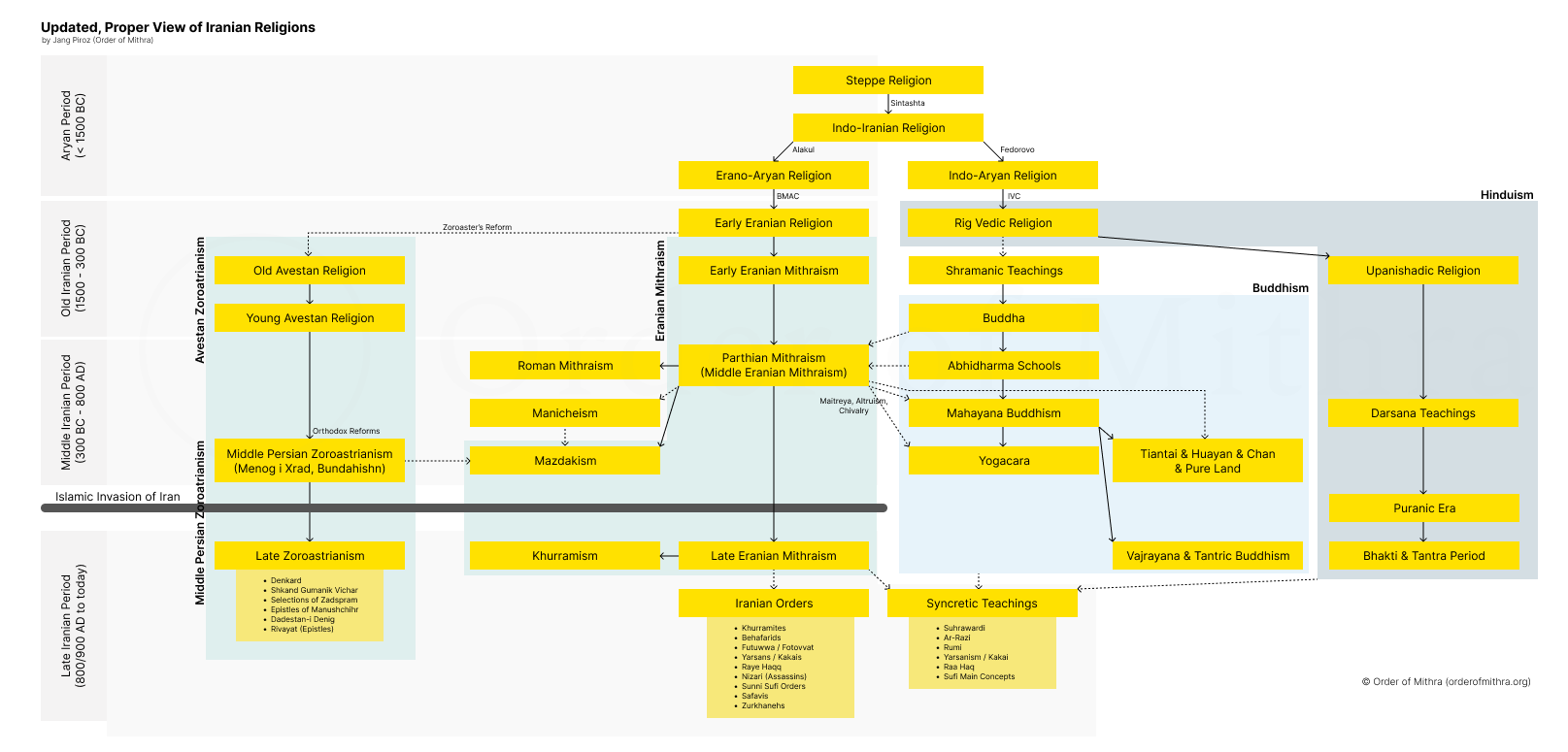
Figure 1: Proper View of Iranian Religions
Now the date. Both branches issue from the same early Eranian religion. On one side, the Old Avestan corpus develops into the Young Avestan; on the other, an early Eranian Mithraism develops into the Parthian religion this essay is concerned with. Through that entire span — the whole Old Iranian period — the two run close together: parallel developments out of one root, sharing cosmology, vocabulary, ritual grammar, and calendar. No sharp confessional boundary can be drawn between Avestan Zoroastrianism and early Eranian Mithraism, and this essay does not draw one. The rupture comes with the orthodox reforms, and it is a rupture within Zoroastrianism as much as between the branches: state-sponsored codification, a written canon, a clerical hierarchy centred in Pars, and a doctrine standardised downward from a royal house. That process is uncontroversial in the scholarship. What this essay adds is only what follows from it — that a reform of that kind selects, and that what it declined to carry forward did not thereby cease to exist in the countryside.
This resolves the strongest objection rather than dodging it. Mary Boyce argued across her History of Zoroastrianism for substantial continuity through the Arsacid period, and her evidence is real: the administrative ostraca from Nisa use Zoroastrian calendar names in the first century BCE, Zoroastrian theophoric naming is widespread among the Arsacid elite, and the later tradition credits an Arsacid king with an early collection of the Avesta. On the account given here, every one of those facts is expected. In the first century BCE the two branches had not yet diverged sharply; shared calendar names are precisely what close siblings produce. A Parthian scribe dating his receipts by Avestan months is not evidence against this argument, because nothing in this argument requires him to have been doing anything else.
Two consequences follow, and they are what the rest of the essay uses. First, the Avestan material belongs to the shared phase and neither later branch owns it — which is why the Mihr Yasht can serve as evidence here without contradiction, and why finding the Chinvat bridge or frashokereti in a Kurdish community six centuries after the conquest points behind Middle Persian Zoroastrianism rather than to it. Second, and more usefully, the location of the rupture tells us exactly where to look for what is not shared: not in the Avestan layer, where the branches agree, but in what the orthodox reforms declined to institutionalise. That is the diagnostic inventory, and it is what Sections IV and VII turn on.
Middle Persian Zoroastrianism is a hierarchical, textual, clerically administered orthodoxy with a universal doctrinal claim. It did not produce, and had no use for, oath-bound brotherhoods, graded initiation under a father, sworn secrecy, sacramental wine sealing a covenant between men, militancy as a religious obligation, or the soul’s return through successive lives. The other branch kept all of it. On the last item the contrast is at its sharpest, because the orthodox alternative is known and is not merely absent but opposite: bodily resurrection at the renovation, not rebirth. Yet the communities Section VII treats hold transmigration explicitly — dūnādūn among the Yarsan, rebirth doctrines reported of the Khurramites in the hostile sources that describe them, and successive regenerations argued philosophically by the Kurdish Illuminationist Shahrazuri in the thirteenth century. Attestation for the Parthian layer itself is lacking and is not claimed. What can be shown is a line that carries rebirth where the orthodoxy carries resurrection.
Suhrawardi, at the end of the sequence, testifies to the distinction himself. He claims descent from an existing Iranian sapiential tradition and states that it is not the tradition of the Zoroastrian books — the Middle Persian books, that is, and not the Avestan layer he draws his own vocabulary from. Scholarship has spent a century calling his philosophy Zoroastrian anyway. He was in a better position to know. The framework is set out at greater length in the author’s A Basic Principle of Eranian Mithraism: Origin; the argument here does not rest on that essay, but on the inventory below.
The Seven Strands: The First Five
From this single pairing, seven distinct semantic strands radiate outward, and every one of them will resurface later in this essay, transposed into an Islamic idiom. The first three are all variations on binding: mithra as covenant and contract in its root sense; Mithra as judge and oath-enforcer, the punisher of those who break faith; and Mithra as the guarantor of warrior fealty, invoked before battle to seal military alliance. A fourth strand softens the first three: Mithra is also friend and companion — the word is cognate with Sanskrit mitra — and it is through this sense that covenant-loyalty stops being merely contractual and becomes personal, and eventually becomes love. A fifth strand is solar: Mithra fuses with Hvare-khshaeta, and in Middle Persian mihr comes to mean simply “sun,” carrying the covenant-god into the vocabulary of light itself.
The Sixth Strand: Unmediated Knowledge
The sixth strand is Mithra as the giver of unmediated knowledge. Its warrant is of a different kind from the other five and should be named as such: where the first five are lexical and directly attested in the Mihr Yasht, this one is inferred from the structure of the cult rather than read off a text. The inference is a good one, and here is what it rests on: this is a god whose own myth is the extraction of light out of stone, whose cult transmitted its content through graded initiation rather than instruction, and whose initiate was required at the summit to look at the Sun directly rather than be told about it. Nothing in that structure is discursive. The knowledge at issue is not conveyed, argued, or taught; it is undergone.
This is the strand the present essay leans on most heavily, and it is also the one most consistently mishandled — largely because of the word that has attached itself to it. Both the tradition’s later exponents and its critics reach for irrational, and the word misleads in opposite directions depending on who is holding it: in the critic’s mouth it means absence of reason, a lapse into confusion or credulity; in the enthusiast’s, it licenses abandoning rigour altogether. Neither is what the sources describe. What they describe is not the negation of discursive reason but what exceeds it — a faculty beginning precisely where inference reaches its limit, and therefore one that can never be reconstructed out of inference’s own materials.
Discursive knowing has a limit because it is bound to utility. Argument, inference, and proof operate on what can be shown, measured, and made to yield an outcome; they are instruments for handling the world and they are superb at it. What they cannot do is verify the ground of the world they handle, because a ground is not an outcome and will not behave like one. Reason describes the order of things while possessing no test that reaches past what is orderable. On this account rationality is not the summit of human knowing but its floor: the most external of the available modes, and the one most completely governed by usefulness.
Above that floor the tradition sets a graded ascent. The Arabic vocabulary for its stages is standard, though the ordering set out here is a synthesis rather than a canonical sequence — Qushayrī, Hujwīrī, and Ghazālī each arrange and define these terms somewhat differently, and no single authority fixes them as four steps. ʿIlm is knowledge in the ordinary sense: what is learned, transmitted, and held. Ḥikma is wisdom, ʿilm ordered by a knower who has understood what he holds. Maʿrifa breaks the pattern entirely, being not knowledge about something but direct acquaintance with it — the knowing a lover has of the beloved rather than the knowing a scholar has of a subject, where the relational sense is definitional and not decorative. And ʿirfan names transformative gnosis, in which the distinction between the one who knows and the thing known stops applying at all. Suhrawardi’s own term for the same structure, ʿilm ḥuḍūrī, states it most plainly: knowledge by presence, in which the known is not represented to the knower but present to him, with nothing standing between.
The Indo-Aryan Parallel
The Indo-Aryan branch of the same root tradition arrives at the identical structure, and the reason it does is worth stating precisely, because the parallel is not a resemblance of vocabulary but a shared consequence of one premise. Discursive reason is the instrument of the ego: it operates by holding an object at a distance from a subject who assesses it, and it exists to secure that subject’s purposes. If the ego is the real self, reason is the highest faculty available and there is nothing above the floor. But every tradition in this family treats the ego as secondary — a construction, not a substance — and once that is granted, the ceiling follows necessarily. Reason cannot reach past the ego, because reason is what the ego does. The higher mode therefore requires the ego’s displacement rather than its greater exertion.
The Indic traditions say this more explicitly than the Islamic ones, and their terminology maps directly. Buddhism’s anātman denies a substantial self outright: what is taken for a person is an aggregate of processes with no owner behind them — which is precisely the claim made at one stage of the Mithraic mystery-cycle discussed below, that one should not say I love but love loves in me, and that what is called personality has no existence of its own to which such forces could belong. Against ordinary discriminative consciousness Buddhism sets prajñā, insight that does not proceed by inference; Vedānta sets jñāna, and the Sanskrit root there is the same Indo-European root that gives Greek gnōsis, so that ʿirfan functions in Arabic as the translation-equivalent of a concept whose Indo-Aryan and Greek names are cognates of one another. Advaita’s formulation is the sharpest available statement of what ʿirfan claims: the distinction between knower and known is not overcome at the summit but seen never to have obtained. And the goal is named, in both families, with the same metaphor of a flame: fanāʾ, passing away, extinction — nirvāṇa, a blowing out.
Zen supplies the clearest demonstration of the mechanism rather than the doctrine. The kōan is a device built for one purpose: to drive discursive reason at full effort into a wall it cannot argue through, until the effort exhausts itself and something else opens. It is a technology for reaching reason’s ceiling deliberately instead of stumbling onto it. The Upaniṣadic neti neti — not this, not this — performs the same operation by negation, refusing every available category until nothing conceptual remains standing.
A limit has to be marked here, and marking it protects the rest. Not all of this material can be inheritance. The Gita’s core is old enough for common descent to be arguable; Advaita as a school is eighth-century and Zen later still, and no amount of shared ancestry explains a system that postdates the split by two millennia. What the later Indic material offers is therefore comparison, not genealogy — the clearest available articulation of a structure the Iranian line reached by its own route. Where genuine transmission can be argued, it runs the other way and in historical time: Mahayana absorbed Maitreya, altruism, and the chivalric ideal from the Parthian sphere it bordered on, and the two branches were in direct contact at exactly the point where this essay’s love strand begins: Balkh, the home of Ibrahim ibn Adham and Shaqiq al-Balkhi, was before the conquest one of the great Buddhist centres of the eastern Iranian world, seat of the Nawbahār monastery whose hereditary custodians, the Barmakids, went on to serve as viziers of the Abbasid caliphate. Inheritance from a common root and documented contact in a shared city are not competing explanations here. They reinforce each other.
From the floor, everything above it is invisible. Reason holds no instrument that registers maʿrifa or ʿirfan and no test that could be built to do so, which is why confirmation in this tradition always arrives downstream — in conduct, in what a life turns out to have become — and never at the moment the claim is made. The discipline that follows from this is non-display, and it follows necessarily rather than as a pious affectation: what cannot be transmitted by argument cannot be demonstrated to an outsider, and so the act of announcing such knowledge is itself evidence of not possessing it. This is the structural reason secrecy recurs at every point in this essay’s material, from the Ayyar oath to the Malāmatī’s deliberate courting of contempt.
Devotion as Method
The strand’s most consequential claim follows from the same premise, and it is the point at which the gnosis strand and the love strand turn out to be one thing. If the higher mode cannot be reached by inference, then it cannot be reached by trying harder at inference: no quantity of argument crosses a boundary that argument does not touch. What carries a person across is devotion — sustained, repeated, unforced orientation of the whole person toward what he does not yet see. Love is not an ornament on this epistemology. Love is its method. The school of love and the school of illumination are therefore not two currents that happened to arise in the same territory and resemble each other. They are a single current described from two sides, the love strand naming the means and the gnosis strand naming the end, which is why Section V finds the same towns, the same generation, and in the case of Tus the same household producing both.
The crossing has a second face, and the two must be held together rather than ranked. Where the later Sufi material describes the passage as devotional — surrender, sustained orientation, the lover’s patience — the older mystery material describes it as agonistic: a deed, a seizure, an endurance under force. Both descriptions name the same structural fact from opposite temperaments. Devotion is not the absence of will but will held steady on something that yields no return; the heroic deed is not the absence of surrender but surrender to a force one refuses to release. Neither is inference, and neither can be produced by inference. The tradition contains both the one who waits and the one who takes hold, and its texts show them to be the same person at different moments of the same ascent.
Two symmetrical errors are refused along the way. To reduce all knowledge to what can be externally verified is to lose everything above the floor; to sever inward insight from embodied conduct is to lose the only ground on which insight can be tested. And one consequence follows that inverts a familiar Greek position: if right knowing is direct seeing rather than accumulated argument, then right character follows from insight rather than from habituation — the Socratic thesis that virtue is knowledge, restored against the Aristotelian account of virtue as trained disposition.
The Mithraic Myth as Epistemology
None of this is a modern description invented to flatter mysticism, and the tradition it descends from did not merely arrange initiation in stages. The Mithraic mythic cycle is this epistemology, told as narrative, and every episode in it concerns the same operation: light extracted from matter by force.
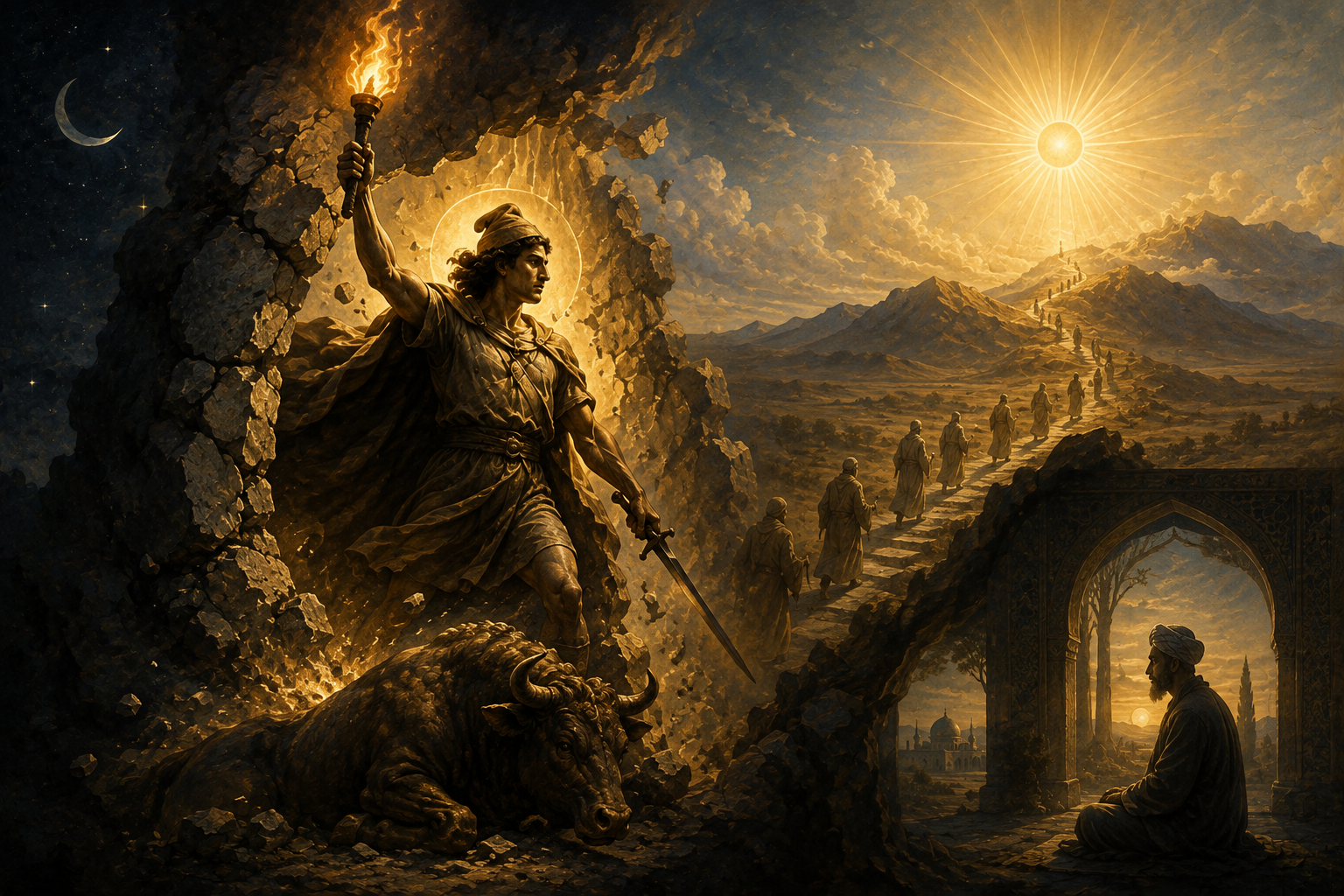
Mithra is theos ek petras, petrogenos — the god generated from the rock, born out of stone beside a river, emerging with a sword in one hand and a torch in the other. He does not descend from heaven. He is broken out of the earth. The rock is the body and the material condition, and the light was inside it all along, requiring extraction rather than importation; the sword is the force by which the extraction is performed, and the torch is what the extraction yields. This single image contains the whole claim of strand six: illumination is not information delivered from outside, it is what becomes visible when the material bond is broken open from within. Only “shepherds hidden on the mountaintops” witness the birth — those already standing above the plain can see it happen at all, which is the same point about invisibility from the floor made above, stated mythically.
A caution about method is owed here. The episodes of the cycle are attested — in Cumont’s assembled monuments, in the reliefs, in the ritual texts. What they mean is not. No ancient source glosses the bull, and modern readings differ sharply: Cumont’s Iranian derivation, Ulansey’s astronomical decoding, Beck’s star-talk. The interpretation offered below follows the initiatory-symbolic reading of the cycle set out by Julius Evola in The Path of Enlightenment in the Mithraic Mysteries (1926), itself built on Cumont, Dieterich, and Mead. Evola read the mysteries as a perennialist looking for a heroic path, and a critic may reasonably ask whether he found what he went in for. The reading is adopted here on its merits and the essay argues from it. It is worth being clear, though, that the sixth strand does not stand or fall with it, because the strand is independently carried by what is attested without any interpretation at all: seven named grades ascending to a father, sworn secrecy, subterranean architecture built in two levels, trials of fire and water, and the apothanatismos text stating in its own words that the initiate seeks to elude the law of Fate governing the lower worlds and to be transformed into the god he has learned to look at. That is a graded, sworn, non-discursive transmission on the documents alone. The symbolic reading that follows adds coherence and explains why the Islamic-era material takes the shape it does; it is offered as an interpretive gain, and nothing in Sections IV through VII depends on it.
On that reading, what Mithra must overcome is the “waters” beside which he is born: the stream of becoming, insatiable craving, the ephemeral certainties on which ordinary lives are built. To be initiated is to be rescued from those waters, to reach the far bank, and thereafter to have the power to refuse what one formerly obeyed. Then comes the wind trial, in which the initiate learns that what he took for his own feelings are impersonal forces passing through him — one should not say I love but love loves in me — and that against such forces the only available act is to remain still and endure. Stillness is not passivity here. It is the sole technique that works at that altitude.
The bull is the culminating episode and the most consequential for this essay. It is the elementary life-force, the vital power bound to matter and resistant to coercion, and Mithra’s deed is neither to flee it nor to dissolve into it. He seizes the horns, mounts it, and is carried on a ride he does not control and never abandons, holding on until the beast exhausts itself and returns to the cave it came from — and only there does he still it and slay it with the dagger, in the name of the Sun. From the wound comes not blood but wheat, and in another version wine: the life-force is not destroyed but transmuted, and what was devouring becomes nourishing. This is why the Mithraic path cannot be read as world-flight. Matter is not denied, escaped, or declared illusory. It is gripped, ridden, endured, subdued, and converted. Illumination is the fruit of that operation and is unavailable without it.
One episode more, and it fuses this strand with the first. Beyond the waters, Mithra confronts the Sun itself — and the confrontation does not end in submission or in conquest but in a pact: a covenant of mutual respect and friendship between the god and the light. Only after that covenant does Mithra become bearer of the Sun’s sovereign power, the hvareno, the Glory that descends upon kings to consecrate them and grant them victory. The covenant-god’s decisive mythic act is to enter a covenant with the light, and sovereignty follows from that covenant and from nowhere else. The initiate at the grade of miles enacted the same principle in a single gesture recorded by Tertullian: offered a sword and a crown, he took the sword and refused the crown, saying that his crown was Mithras. Worldly sovereignty declined; sovereignty from the covenant accepted. Nothing in the material or institutional order confers it.
The institutional form matched the myth exactly. Initiation ascended through seven grades — Raven, the Hidden One, Soldier, Lion, Persian, Sun’s Envoy, and Father — with each rank receiving what the rank below could not yet perceive, precisely the four-step epistemological ascent described above, enacted as ritual rather than written as philosophy. The Mithraea were built underground, with a lower and a higher part, so that the ascent was walked as well as undergone. The trials, as recorded in the scholia transmitted under the name of Nonnus, were fire and water and endurance of cold, hunger, and thirst. And the surviving ritual text known as the apothanatismos states the goal without ornament: the initiate, purified and empowered, aspires to an immortal birth and to elude the law of Fate which rules the lower worlds — liberation from the causal order of matter itself — after which doors burst open, seven beings are disclosed, and Sun-Mithras appears, whom the initiate must learn to stare at without flinching, then vow never to depart from, and finally be transformed into.
What was cultic practice in the second and third centuries becomes, a thousand years later, an explicit philosophical architecture in the writings of a man from a small town in the Zanjan district — a hierarchy of lights descending from the Light of Lights, knowledge as presence rather than representation, and sovereignty descending as xwarnah upon the one who has made the ascent. Suhrawardi did not invent that structure. He wrote down what the mysteries had performed, and he named his own ancestors correctly when he did it — a connection this essay returns to directly in Section V.
The Seventh Strand, and the Fourfold Map
The seventh and final strand is eschatological: Mithra’s role as judge at the reckoning, which becomes, downstream, the root of the messianic material this essay treats in Section V.
The nearest Indo-Aryan analogue to the sixth strand is the Bhagavad Gita’s niṣkāma karma: right action performed as duty, detached entirely from calculating what it will yield, its rightness lying in itself rather than in its outcome. The parallel is real but it must be stated in the right register, because the Gita’s doctrine is an ethics of action rather than a criterion of knowledge — it concerns purity of intention, not how truth is verified. What the two share is the prior move on which both depend: the refusal to let outcome serve as the measure. Once that refusal is made, it constrains ethics and epistemology alike, and the Indo-Aryan branch drew the ethical consequence where the Iranian drew the epistemic one. That is what one expects of two branches working from a common inheritance, not of two traditions arriving at the same place by accident.
These seven strands are not equally weighted, and each feeds a distinct historical current treated later in this essay. Strands one through three, the covenant-and-judgment cluster, are the root of the militant initiatic order. Strands four and five, friendship deepening into devotion and fusing with light, are the root of ishq. Strand six, unmediated knowing, is the root of the illuminationist-gnostic current. Strand seven, judgment at the reckoning, is the root of the messianic material. Four historical phenomena, one semantic root — and the rest of this essay is simply the demonstration of each in turn.
Ahd o Peymān: The Covenant in Persian
The covenant strand left a lexical trace in Persian so direct that it requires no reconstruction at all, and it is worth setting out before the more interpretive material that follows. The standard Persian formula for entering a binding pledge is ʿahd o peymān — a doublet pairing the Arabic ʿahd, covenant, with the Persian peymān, and the phrase ʿahd o peymān bastan, “to bind covenant and pact,” is the ordinary idiom for swearing oneself to something. This pairing of a borrowed Arabic term with a native Iranian one is a common Persian habit, and it is usually a sign that the Iranian word was already in place and was not displaced.
Peymān is exactly such a word. It descends from Middle Persian paymān — covenant, treaty, agreement, and also measure and right proportion — and behind that from an Old Iranian formation on the root meaning to measure. It is not etymologically derived from mithra; the two are separate words. But it carries Mithra’s own function, and it carries it in the language of the territory this essay maps, through the entire Islamic period, without interruption. Its negation makes the continuity plainer still: a peymān-shekan is a covenant-breaker, which is precisely the mithrō-druj of the Mihr Yasht — the contract-violator whom the god pursues across the world with ten thousand eyes and strikes down at the far river. The Avestan crime survives under a Persian name.
The formula’s role in Sufism is not incidental but foundational, and it operates at two levels. Institutionally, the initiate’s pledge to the master — the bayʿa of Section V — is ʿahd o peymān: the disciple binds himself by covenant, in words, before witnesses, exactly as the Ayyar brotherhood of Section IV required. Cosmologically, the tradition traces every such pledge back to a single primordial one. Qur’an 7:172 describes God drawing forth the descendants of Adam before time and asking a-lastu bi-rabbikum, “Am I not your Lord?”, to which the souls answer that they bear witness. Persian Sufism turned this into the ʿahd-e alast, the Covenant of Alast, and the rūz-e alast, its Day — the pledge every soul made before entering existence and then forgot on entering it.
The consequence for this essay’s argument is considerable. On the alast doctrine, love is not a separate impulse that happens to coexist with covenant-keeping. Love is the covenant, experienced from inside time as longing: the soul aches because it remembers having promised, and does not remember what. Hafez returns to this repeatedly, and Rumi’s reed cries because it has been cut from the reed-bed it swore itself to. Sufism’s own account of why ishq exists is therefore a covenant story — which means strand one and strand four of Section II are not two strands that later converged. They were one thing from the beginning, and the tradition says so in its own vocabulary, in a Persian formula whose second word is Iranian.
The Arda–Ḥaqq Convergence
One further piece of philology widens what the argument can include. Parthian develops the Avestan root of Arda, aša-/arta-, through a well-documented regional sound-change — rt becoming hl — into the form ahlaw or ahla, attested in Manichaean Parthian as ahlawān, “the Elect,” those who embody truth-order. This is not a claim of shared descent with the Arabic Allāh, which comes from an entirely unrelated Semitic root; no such etymology is being proposed. What is being proposed is a conceptual convergence available to any Iranian-heritage listener encountering the new religion: among the ninety-nine names of Allah, one — al-Ḥaqq, “the Truth,” “the Real” — occupies exactly the structural position Arda already occupied. Both are the unconditional ground of reality, not fully reachable by inference, approached instead through devotion and direct experience, and both stand as the horizon toward which love ultimately moves. This convergence is what allows the argument to include figures whose central word is Haqq rather than Mithra, provided their doctrine sits in the same structural place. When Mansur al-Hallaj cried Ana’l-Haqq — “I am the Truth” — the standard and least sensational reading is not that he claimed personal godhood, but that he reported a dissolution of the boundary between the self and the unconditional ground of reality: truth was not received from an external authority, it was found by going inward until the distinction disappeared. Ibn ʿArabi’s entire vocabulary of al-Ḥaqq, of tajallī — the self-disclosure of the Real — and of waḥdat al-wujūd, the unity of being, occupies precisely the same position. Ibn ʿArabi stands geographically far outside the Parthian world this essay maps in Section III, and his case has to be handled carefully rather than claimed as support. If the same structure arises in Andalusia without any of the channels of Section IV, then the substrate is not needed to explain its arising, and a rival hypothesis presents itself: sustained contemplative practice may simply generate convergent epistemologies wherever it is undertaken seriously. That hypothesis is plausible and this essay does not dispute it. What it does dispute is that the hypothesis accounts for the corridor. Ibn ʿArabi produced a metaphysics of the Real; he did not produce an oath-bound military order, a graded initiatic hierarchy claiming descent by name from pre-Islamic Iranian sages, and a declared eschatological fulfilment, all within one district and two generations. The single structure recurs. The configuration does not. Hallaj is a different case, and Section V treats him accordingly: born in Fars, but formed, resident, and executed along the corridor itself.
Mithra Beyond Creation: An Interpretive Claim
One further claim belongs here, and it should be stated plainly as what it is: an interpretation, not an inherited doctrine. This essay holds that Parthian-era Mithra-veneration was never oriented toward a single figure sitting within a created pantheon alongside others. It was oriented toward something that precedes and exceeds the created order altogether. The vocabulary for saying this precisely does not come from the Middle Persian sources at all — it is derived, again, from Ibn ʿArabi, whose barzakh names a threshold principle that is neither pure unconditioned being nor the created world itself, but the intermediary through which being becomes manifest as world: something that looks into matter without itself being matter. Read through this vocabulary, the claim is that Mithra-veneration’s true object was the absolute ground standing behind manifestation — manifestation itself being Mazda’s domain — with the visible world and its principle of manifestation understood correctly as a threshold to be passed through, not a destination to rest in. This is this essay’s own contribution to the historical record, argued on identical footing to the claim Suhrawardi himself makes about his own lineage in Section V — a later thinker’s authoritative reading of what an older tradition was always reaching toward, offered openly as such.
III. The Geography
None of this matters historically unless it can be tied to a place, and the place this essay names is not a region but a line.
Between Mesopotamia and Central Asia there runs a single continuous corridor, and it was the most important land route in the medieval Islamic world: the Khorasan Road, the great trunk highway from Baghdad northeast through Hulwan and the Jibal passes to Hamadan and Nahavand, on through Ray, past Qumis and Bastam, into Nishapur and Tus, out across the desert to Merv, and from there to Balkh, Bukhara, and Samarkand. This is not a construct assembled for the present argument. It is the road the Abbasid postal service ran on, the road the Arab armies took east, the road Ibn Khordadbeh and Ibn Ḥawqal measured in stages, and the road along which the whole commerce between Iraq and Transoxiana moved for eight centuries.
Both of its ends are Parthian. The western terminus stands on the Tigris where Ctesiphon, the Arsacid winter capital, had stood; the eastern reach runs through Khorasan, the Parthian homeland proper, and on into the Bactrian and Sogdian territory bound to Khorasan by language and trade. Between those ends the road passes directly through the Pahla zone and the seats of the great houses: through Karen territory at Nahavand and Hamadan, through Mihran territory at Ray, across the Ispahbudhan fief that contains Tus and Nishapur, toward Waraz territory at Merv and Herat. Ekbatana, the Arsacid summer capital in Media, sits on it. The road is the Parthian world laid out end to end as a single traversable line.
This is the claim, stated so that it can be tested: the phenomena this essay tracks distribute along that corridor, with density falling away from it. Not across a region and not throughout an empire — along a road. Read as a list of birthplaces, Section V is very nearly an itinerary of the Khorasan Road’s principal stations.
Two qualifications belong here rather than in a footnote. The corridor has branches, and this essay counts them as part of it: a northwestern spur through Zanjan and Azerbaijan toward the Caucasus, and a southeastern spur out of Khorasan toward Herat, Ghazna, and Zabulistan. And the corridor’s extension into Anatolia is not part of the original geography but the product of a documented migration, traced in Section V through the Wafa’i order’s movement west out of Khorasan under Mongol pressure. What lies off the corridor is treated in Section VIII, where the most instructive absence is southern: the road does not go to Fars.
Each stretch of the corridor carries its own documented Parthian identity, and the identity is not uniform in kind. Khorasan — Middle Persian Abaršahr, read either as “the upper lands” or, on the etymology this essay prefers, as “the lands of the Parni” — was the homeland in the strictest sense, and Parthian language and culture extended from there across the whole northeastern belt into Bactria and Sogdia, through Merv, Hyrcania, and the territory of modern Turkmenistan and Tajikistan, bound to Khorasan by trade, language contact, and centuries of shared political history. Bukhara and Balkh belong to this zone as fully as Nishapur does.
One criterion has to be declared here rather than improvised later, because the argument applies it repeatedly. A place counts as inside this geography by the character of its district and its population, not by the founding date of its buildings. Cities are young; countryside is old. The test has two stages, and both must be met. First, was the district Iranian in speech, administration, and landholding when the city was founded? Second, did that population carry over into the city itself and staff it? A city planted in Iranian country by Iranian administrators is inside; a garrison planted in Iranian country and populated from elsewhere is not, because what a city inherits is decided by who moves into it. The two-stage form matters because the first stage alone would admit almost the whole of lower Mesopotamia. The same test applies to persons: where a man was formed and where he worked count alongside where he was born, and the rule is applied to every figure in Section V without exception.
At the corridor’s western end, Mesopotamia is not periphery but the empire’s administrative core. Ctesiphon on the Tigris was the Arsacid winter residence, paired with Ekbatana in Media as the summer seat, so that Parthian power’s two capitals sit at opposite ends of a single stretch of this same road. Parthian presence asserted itself materially across the region, attested at Hatra and through the vassal kingdoms of Characene, Adiabene, Osroene, and Gordyene under Arsacid overlordship. Baghdad rises, centuries later, on essentially this stretch of the Tigris — some twenty miles from Ctesiphon, in the Sawad, among an Aramaic- and Persian-speaking countryside that had been Arsacid and then Sasanian for six hundred years, and staffed from the outset by Iranian secretarial families, the Barmakids of Balkh among them. The city was new in 762. The district it was planted in was not.
The western, Median zone carries its own name in the sources: Pahla, or Fahla — Isfahan, Ray, Hamadan, Nahavand, and Azerbaijan on Ibn al-Muqaffaʿ’s list, with Dinavar, Mah Sabadhan, and Qazvin added by Ibn Khordadbeh, governed directly by Arsacid noble houses rather than merely conquered by them. The designation itself is attested from the late Arsacid period onward, not invented retrospectively by later geographers, and its dialect-poetry tradition, Fahlaviyat, is understood as the closest surviving direct continuation of spoken Parthian. It was still a living regional speech centuries into the Islamic period: the fourteenth-century historian Hamdullah Mostofi records, as a contemporary observation and not an antiquarian one, that the people of Zanjan — Suhrawardi’s own home district — and parts of Azerbaijan still spoke Pahlavi in his own lifetime. The word carried prestige as well as provenance: asked for his highest term of praise for Rumi’s Masnavī, Jami called it “the Qur’an in the Pahlavi language” — reaching, that is, for the word Parthian.
The Seven Great Houses of the Sasano-Parthian confederation give this geography its sharpest genealogical edge, and a recently published reconstruction of their territories (Varan Pardi, Parthavname, 2022) corrects and considerably enriches the picture. Suren held Sakastan, seated at Zrang and Zabol, with a cadet branch — the Gregorids — seated as far as Amida and Corduene, directly on the Mesopotamia-Anatolia frontier. Karen held Nahavand and Hamadan at the center of the Pahla zone, with two named cadet branches reaching further still: the Kamsarakan into Armenia, and the Pahlavuni into Corduene. Mihran was seated at Ray, extending toward Azerbaijan, standing alongside the separate Arsacid royal line that ruled Armenia in its own right. Zik held Adurbadagan, Azerbaijan, seated near Tabriz. Waraz held the easternmost reach of Khorasan, near Merv and Herat. Esfandyar held Spahan, Isfahan itself. And Ispahbudhan held Tabaristan and Gurgan, extending east through two towns whose names will recur constantly in the pages that follow: Tus, and Nishapur.
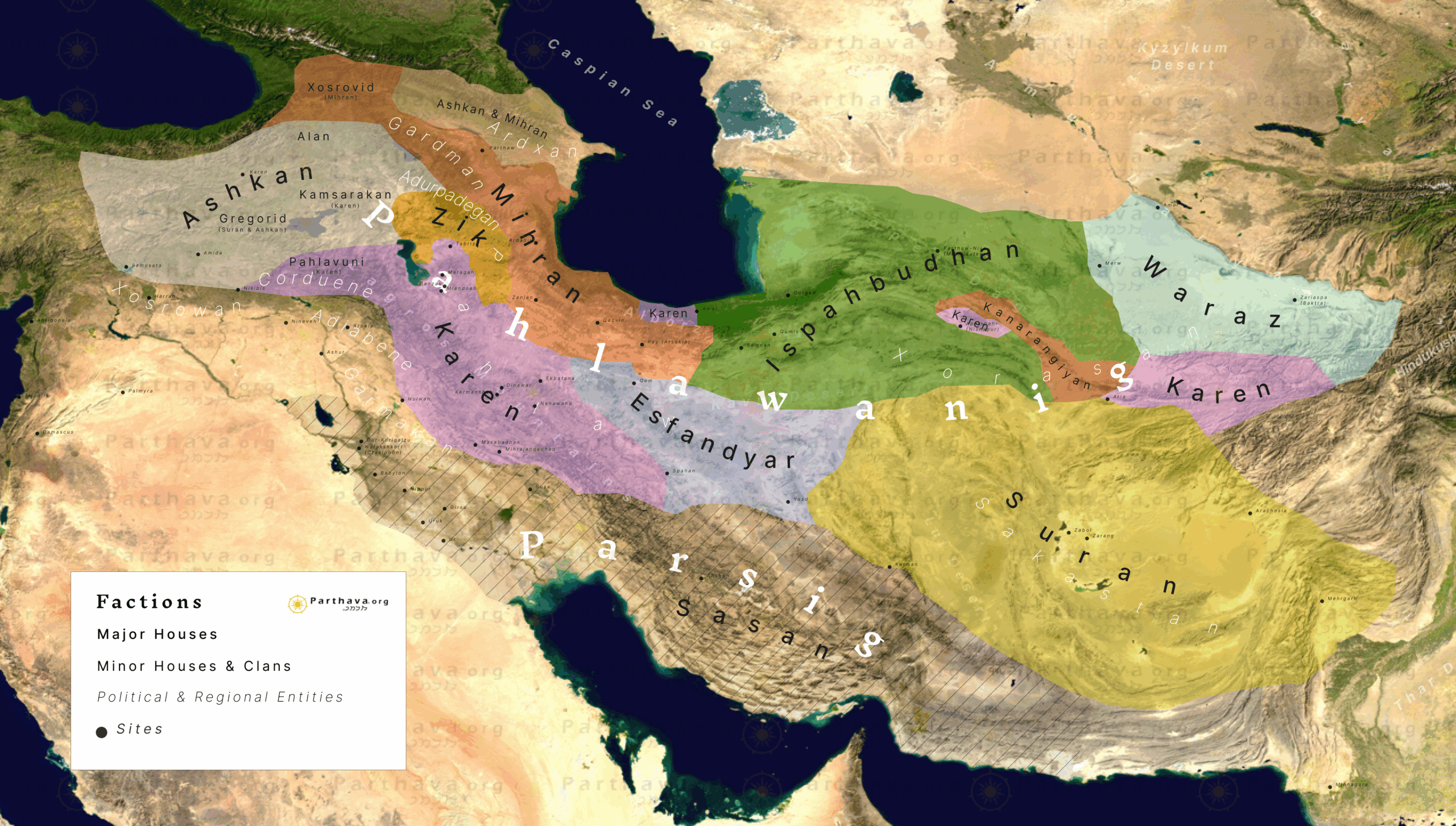
Figure 2: Middle Iranian Houses (parthava.org)
That last detail is worth dwelling on, because it changes what can honestly be said about the figures this essay treats as its central cases. Ahmad Ghazali, his brother Abu Hamid Ghazali, and Farid al-Din Attar are not merely “Khorasani” in the loose regional sense the term ordinarily carries. Tus and Nishapur sit inside Ispahbudhan territory specifically. The founding generation of both the love strand and the gnosis strand traces to a single named great house’s fief. This is not analogy. It is a shared administrative and genealogical ground, documented independently of anything this essay argues about Mithra.
The map underlying Pardi’s reconstruction makes one further point visually that this essay has so far only argued in prose: it labels the seven houses collectively as “Pahlavig,” arcing across the north, and marks the Sasanian royal house’s own territory to the south as “Parsig” — a cartographic confirmation that the Parthian great houses and the Sasanian crown were understood, even administratively, as two distinct things operating within a single confederation. Add to all of this the directly Parthian-descended cadet kingdom of Arsacid Armenia, the Mithridatic kingdom of Pontus in northern Anatolia, and the Parthian client states of Osroene and Adiabene in northern Mesopotamia, and the geography this essay works with reaches the Caucasus, Anatolia, and Mesopotamia on direct genealogical lines rather than by inference — a single continuous field of Parthian identity and influence, not a homeland with a fading periphery.
IV. The Channels of Transmission
Every substrate argument stands or falls on the same question, and it is the question this essay must answer before it names a single Sufi. Semantic resemblance and shared geography establish that two things look alike and sit in the same place. They do not establish that anything passed from one to the other. What is required is a channel: an identifiable institution, text, language, or community carrying the content forward across the intervening centuries.
There is a further and stricter requirement, which this section imposes on itself deliberately. Every channel named here must be demonstrably in place before the Islamic-era figures this essay treats. If the transmission were argued from Hallaj’s vocabulary or Rabia’s asceticism, the reasoning would be circular — the figures would be doing double duty as both evidence of transmission and its product. Accordingly, nothing in this section postdates the Arab conquest. Every channel described below is attested in the Parthian, Sasanian, or immediately post-conquest period, which is to say: the machinery was already running, fully assembled, when the figures of Section V arrive to inherit it. They are downstream recipients. They are not the evidence.
Five channels can be documented, and they overlap.
The Institutional Channel: Roman Mithraism as Proof of Portability
The first channel is not a route into Islam at all, but a demonstration of what the Mithraic tradition was structurally capable of. From the first through the third centuries CE — contemporaneous, as Pourshariati notes, almost exactly with the height of Parthian power — Mithraic mystery associations spread across the entire Roman Empire, from Dura-Europos on the Euphrates to the British Isles, wherever the legions went. These were not diffuse popular devotions. They were formal initiatic societies with a fixed hierarchy of seven grades — Raven, the Hidden One, Soldier, Lion, Persian, Sun’s Envoy, and Father — with sworn secrecy, a shared ritual meal involving wine from the krater, a standardized iconography centered on the tauroctony, and purpose-built underground temples constructed with a lower and an upper part so that ascent was walked as well as undergone. They spread across an alien civilization, in an alien language, among populations with no Iranian ancestry, and they held for three centuries.
What travelled with them was not vague sentiment but the full apparatus described in Section II. The materially attested core is the seven named grades, the standardised tauroctony iconography, the krater of the ritual meal, the two-level subterranean architecture, the rock-birth as depicted in the reliefs, and the trials of fire and water. Carried with that core, and legible in the same reliefs, is the mythic sequence itself: the waters at whose edge the god is generated, the wind trial, the bull seized and ridden and transmuted, and the pact with the Sun. On the reading set out in Section II this sequence is the doctrine rather than its decoration, and the essay reads it that way; a reader who declines the reading still has the formal core, which is enough for the portability argument on its own. One term is deliberately not claimed here: hvareno belongs to the Iranian material and is not attested in the Roman evidence, and Section II’s use of it draws on the Iranian sources rather than these. That content crossed a civilizational boundary intact, without scripture, carried by initiation alone.
The methodological significance is decisive and it is independent of the vexed question of exactly how Roman Mithraism descends from Iranian Mithra-veneration — a question this essay does not need to settle. Whatever the precise genealogy, one fact is established beyond dispute: Mithraic religion possessed, in this very period, the organizational form required to transmit itself intact across cultural and linguistic boundaries, through graded initiation, secrecy, and oath, without written scripture. A tradition demonstrably able to carry itself from Iran’s frontier to Hadrian’s Wall was not a tradition that would find the transition from Parthian to Islamic Iran beyond its capacity. And Dura-Europos matters twice over: it is an Arsacid-period Mithraeum, in Parthian-held Mesopotamian territory, standing physically inside this essay’s Section III geography.
The Brotherhood Channel: The Ayyars
The second channel is the strongest, because here the Mithraic content is not inferred from structure — it is named in the text.
The Ayyars — the chivalrous brotherhoods and sisterhoods of the Iranian world, later Islamicized as the javānmardān and formalized as the futuwwa — are documented in the Parthian epic romance Samak-e Ayyar, whose narrative material Khanlari and Pourshariati after him date to the late Parthian period, around 200 CE, on the text’s own internal reckoning. The dating matters enough to be defended rather than assumed, since the manuscript itself is twelfth-century Seljuq and therefore later than several of the figures the text is used to explain. Two things support the early date independently of the internal reckoning. The world described is pre-Islamic throughout, with the Prophet’s birth appearing as one of the few Islamic markers in five volumes and functioning as a dating reference rather than a religious one. And the oath at the centre of the whole institution is sworn to Mithra by name, before fire, with Allah nowhere in it — which is precisely what a twelfth-century Muslim redactor would have had every reason to remove and no reason whatever to invent. A text that has been through Islamic hands and still swears by Mihr is carrying something older than the hands. What it records is an initiatic brotherhood whose entire ethical architecture is Mithraic in every particular.
Admission required entering a covenant, ʿahd — the first half of the ʿahd o peymān formula discussed in Section II — and swearing an oath, sowgand, and the recurring formula of that oath names its guarantors explicitly: the Just God of Creation, the Light and the Fire, and — “not least of all,” in Pourshariati’s phrase — Mithra and the Seven Stars. The oath is not to Ahura Mazda. It is not to any other Mazdean divinity, and in the Islamic-era recension it is not to Allah. It is, most commonly, to Mithra by name, sworn before fire, exactly as the Avestan material prescribes. Elsewhere an Ayyar asks simply for “Mithra and refuge,” mehr o amān; in one passage Mithra appears under the epithet mehr-e ziā-gostar, the light-spreading Mithra.
Every other element of the practice maps onto a Mithraic function with the same precision. Truth-speaking, rāsti, and the shunning of the Lie, dorugh, form the ethical axis against which every character’s conduct is measured — the Avestan asha/druj opposition intact under Persian names. Giving refuge, zenhār, to the unjustly oppressed is a prime directive, matching the Mihr Yasht’s god with his “endearing affection” for the wronged pauper whose cry reaches heaven. The initiation ritual centered on wine — “I have drunk to your happiness” was the identifying phrase of a man who had joined — paralleling both the wine of the drōn-i Mihrīzed at Mehregān and the krater of the Roman mysteries; drinking alone is treated in the text as near-blasphemous, because the wine’s entire function is to seal a bond. Secrecy was sworn, binding members never to reveal a brother’s secret whatever the cost. They operated by night, shab-ravi, gathering intelligence constantly, mimicking the god’s thousand spies. Their weapons were dagger, bow, and the mace — the gorz, Mithra’s own weapon from the Mihr Yasht, and the same mace handed to a Zoroastrian priest at ordination, acknowledged in orthodox usage as Mithra’s. Archery was the highest of the martial arts, and Samak, the brotherhood’s head, is called one of the world’s great archers. Even the frame narrative encodes the theology: the hero is Khorshid Shāh, the Sun King, endowed with farr-e elāhi, travelling east with his half-brother Farrokh Ruz, “auspicious daylight,” to win Mah Pari, the moon — a solar deity’s transit, told as romance.
Two structural details carry more weight than any individual parallel. The head of an Ayyar association is addressed as pedar, father — the exact equivalent of the Roman pater, the mysteries’ highest grade, appearing independently in an Iranian text. And unlike the Roman associations, the Iranian brotherhoods admitted women, which argues against the Ayyars being a late borrowing from the Roman cult and for both being parallel growths from one Iranian root.
This is the hinge of the entire argument. The Ayyar brotherhood is an oath-bound, graded, secretive, martial initiatic order, swearing by Mithra, attested in a Parthian-period text, and surviving continuously into the Islamic centuries — where, as futuwwa and javānmardi, it becomes the organizational template the Sufi orders adopt wholesale, formally and under caliphal sponsorship, in a process Section V traces through the career of one named man. The militant initiatic order does not need to be derived from Mithra-veneration by argument. The derivation is recorded.
The Doctrinal Channel: Manichaeism
The third channel is textual, missionary, and organized, and it is the one that carries Iranian light-metaphysics into the Islamic period in written form.
Mani, active in Sasanian Mesopotamia in the third century, built a religion on a cosmology of light and darkness as the two primordial principles, with salvation consisting in the liberation of imprisoned light-particles and their return to their source. His community was graded — the Elect above the Hearers, each with distinct obligations and distinct access — and it was aggressively missionary, establishing itself from Roman North Africa eastward through Mesopotamia into Sogdia, Bactria, and eventually Turfan, where its manuscripts survived to be recovered in the twentieth century.
Three features make this a channel and not merely a parallel. First, Manichaeism wrote in Parthian, and it is precisely in Manichaean Parthian that ahlawān — the Elect, the embodiers of truth-order, the direct phonetic descendant of Avestan arta- through the regional rt > hl development — is attested. The Arda-vocabulary of Section II survives, in writing, inside a Manichaean religious lexicon, as a technical term for an initiated grade. Second, the geography of Manichaean missionary success is this essay’s geography exactly: Mesopotamia, Khorasan, Bactria, Sogdia. Third, and most importantly for the chronological requirement, Manichaeism did not end with the Sasanians. Manichaean communities persisted in Mesopotamia and Central Asia well into the Abbasid centuries — persisted visibly enough that zindīq, the accusation of Manichaean heresy, became a standing charge in early Abbasid Baghdad, levelled at figures as prominent as Ibn al-Muqaffaʿ, whose regional definitions of Pahla this essay cites in Section III. The channel is attested by the anxiety of those trying to close it.
Manichaeism is not Mithraism, and no claim is made here that it is. It is a vector: an organized, literate, graded, missionary Iranian religion, carrying light-ontology and the Arda-lexicon through the exact territory and into the exact centuries this essay requires.
The Syncretic Channel: Mesopotamia
The fourth channel is the least tidy and the most persistent. Parthian and Sasanian Mesopotamia was not religiously unified; it was a zone of continuous exchange in which Iranian, Semitic, Hellenistic, and gnostic material met and recombined, and several of its products survived the conquest intact.
Hatra, in Parthian-held territory, preserves the material record of Iranian religious presence layered over local Mesopotamian cult. Edessa and Osroene, Parthian client states, produced Bardaisan and his school, whose cosmology fused astral speculation with Iranian dualist material and whose influence ran through Syriac Christianity for centuries. Harran, most consequentially, maintained a planetary and astral religion continuously through the Sasanian period and into the Islamic one, its community negotiating recognition as “Sabians” under Muslim rule and supplying the Abbasid translation movement with some of its most important figures — Thabit ibn Qurra among them. Southern Mesopotamia’s Mandaeans, an Aramaic-speaking gnostic community with light-metaphysics, an elaborate initiatic priesthood, and a strict discipline of secrecy, survived the conquest and survive still.
None of these is a Mithraic community. What they establish is that Mesopotamia — this essay’s Parthian imperial core, from Ctesiphon to Hatra — sustained, without interruption across the conquest, multiple organized religious bodies holding light-ontology, astral cosmology, graded initiation, and sworn secrecy as their working equipment. The environment into which Islamic mysticism emerged in Mesopotamia was not a blank one. It was saturated.
The Social Channel: The Dehqāns and the Living Language
The fifth channel is the quietest and probably the broadest. The Arab conquest removed a dynasty; it did not remove the landed Iranian gentry, the dehqāns, who continued to administer their districts, hold their estates, and transmit their own historical and religious traditions orally across generations. It is from precisely this class that the material eventually gathered into the Shahnameh descends — proof that pre-Islamic Iranian tradition survived the conquest in transmissible form, in the countryside, outside any institution the new order controlled. The Parthian great houses of Section III are the upper reach of exactly this stratum, and the Ispahbudhan fief around Tus and Nishapur is where its most consequential later output appears.
Language carried the same freight. Fahlaviyat, the dialect-poetry tradition of the Pahla zone, is the closest surviving continuation of spoken Parthian, and Zanjan’s own speech was still being recorded as Pahlavi by a contemporary historian in the fourteenth century. Whatever a language carries, this one was still carrying it, in the mouths of the population, in the district that produced this essay’s central figures.
The Signature: Graded Initiation
One structural feature recurs across every channel above, and its recurrence is the section’s strongest single observation. Roman Mithraism ascended through seven grades to the pater. The Ayyar brotherhood was entered by oath and led by a pedar. Manichaeism divided Elect from Hearers, with distinct access at each level. Mandaean priesthood was graded and initiatic. And Suhrawardi’s Ḥikmat al-ishrāq, at the far end of the sequence, describes reality itself as a graded hierarchy of lights in which each rank receives what the rank below cannot yet perceive. The Ismaili daʿwa is deliberately left off this list: its ranked structure was developed in Fatimid Egypt and the Yemen rather than in Iran, and Section VIII treats the concession in full.
This is one structure, appearing in five institutional forms across a thousand years and one continuous territory: truth held in stages, released downward through a bound hierarchy, verified by ascent rather than by argument. It is strand six of Section II, and it is the mechanism by which every other strand travelled.
V. Four Strands in the Early Islamic Era
With the corridor and the channels established, the four downstream currents can be traced along it directly, each strand followed roughly in chronological order. One note on the sorting, since several figures could plausibly sit in more than one place: assignment follows a figure’s institutional consequence, not the register of his writing. Junayd’s contribution is doctrinal, but what the doctrine made possible was the order, so he stands under covenant. Hamdun al-Qassar’s concealment is an institutional discipline, but its object is the state of the individual soul, so he stands under gnosis. The criterion is applied consistently and the roster in the appendix follows it.
The Covenant/Order Strand
With that institutional continuity established, the strand’s individual figures can be read as what they are: successive expressions of an organizational form already Mithraic in origin.
The pattern begins before Islam ever arrives. Bahram Chobin, of the House of Mihran, was Ray’s and Media’s most celebrated general under the last Sasanian kings, and his career establishes the template the rest of this section follows: a named Parthian great house producing a figure whose authority rests on martial loyalty rather than royal blood. That pattern reasserts itself almost immediately after the Arab conquest. Sunpadh — whose attachment to the House of Karen rests on the Iranian genealogical tradition rather than on contemporary record, and should be read as such — led an armed uprising against the Abbasid Caliphate from Nahavand in the 750s — a named Parthian great house engaging the new imperial order in exactly the kind of oath-bound resistance its own dynastic history had trained it for. A generation later, Babak Khorramdin led the Khurramite uprising from the mountain fortress of Badhdh in Azerbaijan, from 816 to 838, fusing residual Mithraic and other Iranian doctrine with sustained armed resistance to Abbasid rule — militancy and heterodoxy operating as a single movement rather than as separable concerns.
The strand’s clearest institutional case, however, belongs to the twelfth century. Hasan-i Sabbah founded the Nizari Ismaili order at the fortress of Alamut in Rudbar around 1090, and his central doctrine — the daʿwa jadīda, the “new preaching” — is worth stating precisely, because it is the covenant strand’s epistemology as much as its politics. Sabbah’s argument, set out in his doctrine of taʿlīm, authoritative instruction, holds that reason alone cannot establish religious truth: two men reasoning honestly from the same premises reach opposite conclusions, so reason cannot be the arbiter. What is required is a living, present, authoritative teacher — the imam — whose instruction is received rather than deduced. This is strand six of Section II in explicitly institutional form: truth transmitted downward through a graded hierarchy to those bound into it by oath, never established by argument between equals. Alamut’s fortress network, holding for a century and a half, was the political expression of an epistemological claim.
Almost contemporaneously, in the small town of Suhraward near Zanjan, Abu Najib al-Suhrawardi and his nephew Abu Hafs Umar al-Suhrawardi founded and then formally systematized the Suhrawardiyya — and the nephew’s role deserves emphasis, because Abu Hafs Umar was appointed shaykh al-shuyūkh of Baghdad by the caliph al-Nasir and worked directly on the caliph’s project of reorganizing the futuwwa brotherhoods into a chivalric order under caliphal authority. The line from the Ayyar material above to institutional Sufism is not inferred here; it runs through a single named man’s career. His ʿAwārif al-maʿārif became one of the standard handbooks of the Sufi path, codifying the master-disciple bond, the ṣuḥba, as a formal relationship of oath and obedience rather than informal association. Abdul Qadir al-Jilani, working from Gilan in the same century, founded the Qadiriyya on a doctrine that reads as the covenant strand at its most explicit: the disciple’s bayʿa, the pledge of allegiance to the shaykh, understood as continuous with the pledge given to the Prophet, transmitted through an unbroken chain — a covenant whose binding force derives entirely from the integrity of its transmission.
Junayd of Baghdad belongs in this same Mesopotamian core rather than at its margin, and his doctrinal contribution is the strand’s theoretical foundation. Against Bayazid’s ecstatic sukr, intoxication, Junayd formulated sahw — sobriety, the return to lucid consciousness after annihilation in the divine — and with it the paired doctrine of fanāʾ and baqāʾ: the self is annihilated, and then subsists again, restored to the world with its obligations intact. This is precisely why the covenant strand needs him. An ishq that ends in annihilation cannot build an order; an ishq that annihilates and then returns can be bound into hierarchy, discipline, and duty. Junayd’s sobriety is what makes the militant order theologically possible at all.
One further case belongs here, and it is the strand’s most consequential long-term legacy. Abu’l-Wafa al-Baghdadi founded the Wafa’iyya order in Baghdad in the late eleventh century — a city that, on the geography established in Section III, sits squarely inside the Mesopotamian Parthian core rather than outside it. The order was carried east and then west again: transmitted through Dede Garkin to Baba Ilyas al-Khorasani, whose very name records his Khorasani origin, and who carried the order into Anatolia, where his own follower, Baba Ishaq, led the Babai Revolt of 1239 to 1241 against the Seljuk Sultanate of Rum — an armed uprising in which Baba Ishaq proclaimed himself nothing less than a messenger of God. Here the covenant strand and the eschatological strand fuse into a single historical event, migrating the full length of the Khorasan-to-Anatolia axis this essay’s geography maps, and the Babai movement stands as the direct institutional ancestor of the later Bektashi order.
The Love Strand
The love strand’s earliest generation belongs almost entirely to Balkh and its immediate surroundings. Ibrahim ibn Adham, a prince by tradition who renounced his throne for the road, and Shaqiq al-Balkhi after him, establish the doctrine that would define early Khorasani asceticism: tawakkul, absolute trust, taken to its logical extreme as the refusal to provide for oneself at all, on the grounds that provision is the divine’s obligation and not the servant’s concern. Shaqiq is credited with making tawakkul a formal station of the path rather than a private virtue. What matters for this essay is the structure of the claim: right action is not validated by its outcome, and calculating provision is itself a failure of trust — the same rejection of outcome-measured conduct that Section II identified in niṣkāma karma, arriving here as a practical discipline rather than a philosophical position.
Bayazid Bastami, from Bastam, pushes the impulse further than anyone before him and gives the strand its first vocabulary of annihilation. His shaṭaḥāt reach us through Sarraj and Sahlagi rather than from his own hand, and the tradition around him is hagiographical in texture throughout; what follows is what the tradition preserved, which is the historically consequential thing regardless of what he said verbatim. The ecstatic utterances — “Glory be to me,” “I am I; there is no god but I” — assert that in fanāʾ, the extinction of the self, no separate self remains to do the speaking. This is the same claim Hallaj would be executed for a generation later, and its structure is the one Section II described through Hallaj’s Ana’l-Haqq: the boundary between the self and the ground of reality dissolves inward, without any external mediator. Bayazid also formulated the doctrine of miʿrāj, the mystic’s own ascent, modelled on the Prophet’s — a graded ascent through stations toward unveiling, which is strand six’s structure again in devotional rather than philosophical dress.
Abu’l-Hasan Kharaqani, an illiterate farmer whose tradition has him initiated by Bayazid’s spirit thirty years after Bayazid’s death — a hagiographical claim, but a revealing one, since it asserts that the transmission is real without requiring a living teacher — and Abu Sa’id Abu’l-Khayr of Mihna, extend this into settled communal practice in the following century. Abu Sa’id’s contribution is doctrinally significant beyond his verse: he institutionalized the khānqāh, the Sufi lodge, with a written rule governing communal life, and he is the figure who makes love-poetry — including frankly erotic imagery — a legitimate vehicle of religious expression rather than a suspect indulgence. The move matters because it establishes the interpretive convention on which the entire later school of love depends: the beloved, the wine, the tavern all read simultaneously as themselves and as the divine.
The strand reaches its theoretical high-water mark with the brothers of Tus. Ahmad Ghazali’s Sawāniḥ al-ʿushshāq is the foundational systematic treatise of love-mysticism proper, and its central doctrine inverts the ordinary devotional relation entirely: ishq is not something the lover directs toward the beloved but a single reality in which lover, beloved, and love itself are one, and in which the lover exists only as love’s instrument. Ghazali holds that love precedes and grounds knowledge rather than following from it — one does not love what one has come to know, one knows only through loving — which places ishq on the same epistemological footing Section II assigned to unmediated knowing. His most consequential move for this essay’s argument is his reading of Iblis as the perfect lover: commanded to bow to Adam and refusing, Iblis chose obedience to the divine unity over obedience to the divine command, accepting eternal damnation rather than direct his worship elsewhere. Love is thereby established as a higher authority than law, and fidelity to the covenant as taking precedence over the letter of the instruction — the covenant strand’s logic surfacing inside the love strand’s central text.
His student Ayn al-Qudat Hamadani radicalized all of it from Hamadan and was executed at thirty-three for having done so. His Tamhīdāt argues that the highest knowing lies past the reach of intellect altogether, that the Prophet’s own light and Iblis’s darkness are complementary rather than opposed necessities within a single divine order, and that the pīr, the living master, is the indispensable mediator of the path — a claim structurally identical to Hasan-i Sabbah’s taʿlīm, developed independently and in the same decades. He was killed for the doctrine, which is itself evidence of how far outside the ordinary religious settlement it stood.
Farid al-Din Attar, from Nishapur, gives the strand its most durable literary form and closes its founding period in the most literal way possible. His Manṭiq al-ṭayr stages the path as a migration: thirty birds cross seven valleys to reach the Simurgh, and find at the end only sī murgh — thirty birds — the sought-for divine turning out to be the seekers’ own annihilated selves. The doctrine is Bayazid’s fanāʾ, rendered as narrative, and the sevenfold graded valley-structure is once again the initiatic ascent of strand six. Attar dies in the Mongol sack of his own city around 1221, and his death marks, almost to the year, the end of the pre-Mongol world this essay confines itself to.
The Gnosis Strand
Ray produced two figures who belong here for different reasons. Abu Bakr al-Razi argued on purely rational grounds that universal reason renders prophetic revelation unnecessary — a heterodoxy of a kind the corridor produced repeatedly, and one that shares with the gnostic material a refusal of institutional mediation, though it should not be assimilated to it: Razi rejects prophetic authority, where the gnostics reject discursive proof. Those are different targets and the essay does not conflate them. Ibn Miskawayh, also of Ray, extends the same city’s rationalist-ethical tradition a generation later.
Mansur al-Hallaj is the strand’s most consequential figure and the one whose placement needs stating. On the criterion declared in Section III, Hallaj belongs inside it rather than outside. He was born at Tur in Fars, but he was formed and destroyed along the road: schooled at Basra and then Baghdad, resident in Baghdad, executed there in 922 — and in the intervening decades he travelled the corridor’s full eastern length, through Khorasan into Transoxiana and beyond. The most radical single utterance in the tradition’s history — Ana’l-Haqq, truth found by going inward rather than received from any external authority — was made by a man whose adult life traced the Khorasan Road end to end.
Ibn Sina, born near Bukhara, belongs fully within the Khorasan-Bactria-Sogdia zone established in Section III, and two elements of his system point directly at this strand rather than away from it. The first is his doctrine of the ʿaql al-qudsī, the sacred intellect: the highest form of knowing occurs when the human intellect receives intelligibles directly from the Active Intellect without passing through inference at all — instantaneous ḥads, intuition, which Ibn Sina holds is how prophets know. A qualification is owed here, because the illuminationist reading of Ibn Sina is contested and this essay does not need the strong version of it. For Ibn Sina ḥads remains an intellectual act — the immediate acquisition of the middle terms of a syllogism without having to search for them — rather than a non-discursive seeing; Dimitri Gutas has argued the point forcefully against Henry Corbin’s reading, and Gutas has the better of it. The same caution applies to the late and partially surviving ḥikmat mashriqiyya, the “Eastern philosophy,” and to the visionary recitals — the Recital of the Bird, Ḥayy ibn Yaqẓān — where philosophical argument gives way to allegorical ascent narrative. What survives the qualification is modest and still worth having: Islam’s foremost Aristotelian ranked an immediate, unsought grasp above the labour of demonstration, and chose allegory when he wrote about the summit of the path.
Nasir-i Khusraw, from Qubadiyan in the Balkh region, carries the strand into institutional transmission through the Ismaili daʿwa, and his central doctrine is the one that gives the whole Ismaili tradition its epistemological shape: taʾwīl, the hermeneutic drawing-back of the outward ẓāhir to reveal the inward bāṭin. Scripture and law have an exterior available to anyone and an interior available only through authorized instruction — which makes the graded initiatic structure not an organizational convenience but a necessity of the doctrine itself. Truth is layered, and access to each layer is granted, not achieved.
Abu Hamid al-Ghazali, brother of Ahmad and fellow son of Tus, supplies the strand’s most important testimony precisely because he approached it from the other direction. His Tahāfut al-falāsifa dismantles the philosophers’ claims to demonstrative certainty on their own logical terms — most consequentially in his attack on necessary causation, arguing that the observed conjunction of cause and effect establishes habit rather than necessity. Having shown by argument that argument cannot reach certainty, his al-Munqidh min al-ḍalāl records what followed: a collapse into radical doubt from which neither theology, philosophy, nor Ismaili authority could extract him, resolved only by dhawq — direct tasting, the unveiling given to the Sufi path. The conclusion he draws is exactly strand six’s claim, and it is stated by the era’s foremost authority on Islamic law: the highest truths are not demonstrable, only tasted, and the taste is not transferable to anyone who has not had it.
Two figures belong here whose absence would be conspicuous, and both sit squarely on the corridor. Ḥakīm al-Tirmidhī (d. c. 910), from Termez on the Oxus, is the earliest Islamic thinker to build a systematic light-metaphysics of the heart, and the author of the doctrine of walāya — sainthood as a graded hierarchy of the divinely befriended, culminating in a seal at its summit. A ranked hierarchy of illuminated friends of God, worked out in Bactria in the ninth century, is strand six’s structure two and a half centuries before Suhrawardi, and the word at its centre, walī, means precisely friend. Khwāja ʿAbdullāh Anṣārī (1006–1089) of Herat, at the corridor’s southeastern turn, maps the path in his Manāzil al-sāʾirīn as a hundred graded stations from awakening to annihilation — the most exhaustive ascent-architecture the tradition produced, composed in the same generation as Nasir-i Khusraw and a day’s ride off the Merv road.
The corridor also produced the men who codified all of this into transmissible doctrine, and their concentration in two adjacent towns is itself part of the evidence. Abū Naṣr al-Sarrāj (d. 988) of Tus wrote the Kitāb al-Lumaʿ, the first systematic defence and exposition of the Sufi path. Abū ʿAbd al-Raḥmān al-Sulamī (937–1021) of Nishapur compiled the biographical record on which all later knowledge of the early figures depends, and wrote the surviving treatise on the Malāmatiyya. Abū’l-Qāsim al-Qushayrī (986–1072), also of Nishapur, produced in his Risāla the handbook that made the tradition teachable across the Islamic world. Abū Bakr al-Kalābādhī (d. c. 990) did comparable work at Bukhara, and ʿAlī al-Hujwīrī (d. c. 1073) carried it into Persian prose from Ghazna on the southeastern spur. Every foundational systematising text of Sufism was written within a few days’ travel of the Khorasan Road, and four of the five within its Khorasani stretch.
Hamdun al-Qassar, in Nishapur, founds the Malāmatiyya on the inverse discipline. Where the Ayyar concealed the brotherhood’s secrets from outsiders, the Malāmatī conceals his own spiritual attainment from everyone, deliberately courting blame and public contempt to destroy any possibility of reputation — since a reputation for sanctity is itself a form of self-regard, and therefore an obstacle. Qassar’s rule that one should hold others’ faults lighter than one’s own, and that any state visible to others is thereby compromised, makes concealment a technical requirement of the path rather than mere modesty. It is the same logic as initiatic secrecy, turned inward on the self.
The strand’s culmination is Yahya Suhrawardi al-Maqtul, executed at Aleppo in 1191 at thirty-seven, from the town of Suhraward near Zanjan, and his system is the point at which everything this essay has traced converges into explicit doctrine. His Ḥikmat al-ishrāq replaces Aristotelian substance-metaphysics with light: reality is a single graded hierarchy of lights descending from the Nūr al-anwār, the Light of Lights, each rank illuminating the rank below and receiving from the rank above, with darkness being not a substance but merely light’s privation. Knowledge, correspondingly, is not the acquisition of concepts but ʿilm ḥuḍūrī — presential knowledge, in which the knower is directly present to the known with nothing standing between them, as distinct from the representational knowledge that propositions and syllogisms deliver. He is explicit that discursive philosophy is a preparation and not an arrival: the ḥakīm who reasons without tasting is incomplete, the one who tastes without reasoning is a mystic but not a sage, and only the ḥakīm mutaʾallih, the “deiform sage” who has both, stands at the top of his hierarchy.
Two further features make him this essay’s central exhibit rather than merely its strongest case. He claims his lineage explicitly and by name — the khusrawānī wisdom of ancient Persia, running through Zoroaster and Kay Khusraw, which he holds was transmitted alongside and independently of the Greek line, and he adopts Avestan and Middle Persian terminology directly into his metaphysics, most notably xwarnah as the light of sovereignty descending on the just ruler. And his graded hierarchy of illuminated souls, each receiving what the rank below cannot yet perceive, is not a loose echo of the Mithraic mystery-initiations described in Section II. It is the same structure, made into formal epistemology eight centuries after the historical Mithraic cult ceased to exist as organized practice, by a man who named Iranian sages as his own authorities, in a town whose own contemporary historian still called its language Pahlavi.
Two figures belong to this strand from entirely outside the geography this essay has mapped, and Section II has already set out how they must be handled. Ibn Rushd of Córdoba is the rationalist counter-pole, and Ibn ʿArabi of Andalusia is the closest non-Iranian parallel to the strand’s light-ontology and its claim of unmediated knowing. Neither can be counted as support. If the structure arises at the far edge of the Islamic world without any of the channels of Section IV, then the substrate is not required to explain its arising, and the rival hypothesis stands: serious contemplative practice may generate convergent epistemologies wherever it is undertaken. What the Andalusian cases do not produce is the rest of the configuration — no oath-bound order, no graded initiatic hierarchy, no claim of descent by name from pre-Islamic Iranian sages, no declared eschatological fulfilment. The single structure recurs. The configuration does not, and that is the whole of the claim.
The Eschatological Strand
The fourth strand descends from frashokereti, the renovation of the world, and the Saoshyant, the world-saviour who brings it about — with Mithra’s own role as judge at the reckoning layering a further and more specific charge on top of that older substrate. Its distinguishing feature in the Islamic period is that the renovation is claimed as present rather than deferred, and every major instance of the claim falls on the corridor.
It surfaces immediately after the Abbasid revolution. Abu Muslim, the Khorasani general who made that revolution and was murdered by the caliph he installed, became within a generation the object of cults holding that he had not died and would return — millenarian, organised, and specifically Khorasani, arising along the eastern stretch of the road within a decade of 755. The pattern recurs in the Khurramite movement in Azerbaijan on the northwestern spur, where Babak’s rising carried an expectation of restored justice.
Its most radical institutional expression came at Alamut in Rudbar. On the eighth of August, 1164, Hasan II proclaimed the qiyama — the Resurrection itself — not as an event to be awaited but as one already actualised in history through the person of the imam; the ceremony was repeated shortly after at Muminabad in Quhistan. Law was thereby declared fulfilled rather than abrogated, and the community was told it was living after the end. No comparable claim was made anywhere else in the medieval Islamic world.
And it returns, fused with the covenant strand into a single act, when Baba Ishaq proclaimed himself a messenger of God at the head of the Babai Revolt in 1239 — at the Anatolian end of the migration this section has just traced, carrying both strands west out of Khorasan together.
VI. Convergence
An argument of this kind is usually only as good as its densest single point, and this essay’s densest point is very small: a minor town in the Zanjan district, and a mountain valley some seventy miles east of it, in the middle decades of the twelfth century.
Start with the town. Suhraward lay on the northwestern spur of the corridor, in the Jibal, in territory the Karen house had held and in a district whose speech Hamdullah Mostofi was still recording as Pahlavi two centuries later. It was not a capital, a court, or a centre of learning. It appears in the geographers as a modest place on the road between Zanjan and Sultaniyya. From it, within a single lifespan, came both of the following.
Abu Najib al-Suhrawardi (1097–1168) left Suhraward for Baghdad, studied law, abandoned a professorship for the path, and established a ribāṭ on the Tigris that became the training house of an order. His nephew Abu Hafs Umar al-Suhrawardi (1145–1234), born in the same town, inherited that house and turned what his uncle had founded into an institution: he wrote the ʿAwārif al-maʿārif, which became the standard handbook of the Sufi path for centuries; he was appointed shaykh al-shuyūkh of Baghdad, the caliphate’s senior Sufi office; and he worked directly on the caliph al-Nasir’s programme of reorganising the futuwwa brotherhoods — the direct institutional descendants of the Ayyar associations of Section IV — into a chivalric order under caliphal authority. He was also sent as the caliph’s ambassador to the courts of the age. In one man’s career, the Ayyar covenant-brotherhood and institutional Sufism are visibly the same institution, being administered by the same hand.
Yahya al-Suhrawardi (1154–1191), called al-Maqtūl, the Murdered, was born in that same town nine years after Abu Hafs Umar. He is not known to have been a relative. He went the other way — west and south rather than to Baghdad — studied at Maragha and Isfahan, and arrived at Aleppo, where he was executed at thirty-seven on the order of Saladin, at the demand of the jurists, for the content of his teaching. That teaching was the Ḥikmat al-ishrāq: reality as a graded hierarchy of lights descending from the Light of Lights, knowledge as ʿilm ḥuḍūrī, sovereignty descending as xwarnah upon the just, and an explicit, named claim of descent from the khusrawānī wisdom of pre-Islamic Iran through Zoroaster and Kay Khusraw.
So: one small town on the Pahlavi-speaking stretch of the corridor produces, in one generation, both the tradition’s most durable institutional order and its most complete philosophical statement of unmediated knowledge — the covenant strand and the gnosis strand of Section V, arriving simultaneously from the same handful of streets. The two outputs are the exact pair this essay has argued are two faces of one inheritance. They are not related by influence: Abu Hafs Umar was a Baghdad establishment figure and Yahya was killed as a heretic. They are related by origin.
Now the valley. Seventy-odd miles east of Suhraward, in the Rudbar highlands above Qazvin, the Nizari fortress of Alamut had stood since Hasan-i Sabbah took it in 1090. Its doctrine was taʿlīm: reason cannot arbitrate religious truth, because honest men reasoning from the same premises reach opposite conclusions, so truth requires a living authoritative teacher and is received rather than deduced. That is strand six of Section II converted into a constitution. And in 1164 — while Abu Najib was still alive, while Abu Hafs Umar was a young man, thirteen years before Yahya Suhrawardi began writing — Hasan II stood at Alamut and declared the Resurrection present.
Three of the four strands this essay has tracked therefore reach their defining early-Islamic expression inside two generations, within one short stretch of a single road, in a region whose inhabitants were still speaking a descendant of Parthian: the institutional covenant-order at Suhraward and Baghdad, the philosophy of unmediated knowledge at Suhraward and Aleppo, and realised eschatology at Alamut. The fourth strand, love, had reached its own theoretical summit forty years earlier at Tus and Hamadan, both of them likewise on the corridor, in the persons of Ahmad Ghazali and his executed student.
What would have to be true for this to be coincidence? Roughly: that the Islamic world’s most durable Sufi order, its most fully developed light-metaphysics, its most radical eschatological claim, and its most systematic love-doctrine all emerged within seventy years and a few hundred miles of one another, in a linguistically marked Parthian-descended district, by unrelated accident. That is a defensible position only if one has already decided that substrates do not exist. The alternative explanation is simpler and requires no coincidence at all: something was there, in that specific territory, and these are the forms it took when it surfaced.
VII. Continuation After the Mongol Rupture
The Mongol invasions close this essay’s period; they do not close the tradition. What follows is not a treatment of the later material — each figure and community named here deserves its own study — but the demonstration that every strand identified above continues past 1250, in the same geography, and in several cases under names that state the argument of this essay outright.
The love strand. Rumi, born at Balkh in 1207 and carried west by his family’s flight ahead of the Mongols, gives ishq its most widely read expression in the Masnavī and the Dīvān-e Shams — the Ispahbudhan-Khorasani inheritance of Section V transplanted to Konya. Jami’s verdict on the result, quoted in Section III, is the one this essay could not have improved on had it invented it: a fifteenth-century Sufi authority, asked for his highest term of praise for the tradition’s central text, reached for the word Pahlavi — that is, Parthian.
The structure of Rumi’s own transformation deserves separate notice, because it reproduces the pattern of Section II with unusual precision. Pourshariati’s reading of Samak-e Ayyar identifies its narrative spine as solar: the hero is Khorshid Shāh, the Sun King, bearing farr-e elāhi, accompanied by his half-brother Farrokh Ruz, “auspicious daylight,” and the romance’s engine is the sun’s progress toward union with the moon. Rumi’s life turns on the same figure. In 1244 at Konya he met a wandering dervish named Shams-e Tabrīzī — Shams, the Sun, the Sun of Tabriz — and the encounter converted a respected jurist and preacher into the tradition’s greatest poet. The bond between them was not erotic in the ordinary sense, and not that of master and pupil in the ordinary sense either; it was companionship, brother-love, the sworn intimacy of two men, and it was total.
The decisive evidence is not the name but the act. When Shams vanished, Rumi’s grief produced the Dīvān — and he did not sign it with his own name. He titled it for the Sun, attributing the whole of his own verse to the sun-figure whose light had made it possible. A poet disclaiming authorship of his greatest work in favour of a man called Sun is doing something more specific than punning on a common Arabic name.
Read against Section II, this is the Mithraic mythic sequence enacted biographically. Mithra’s decisive act is a pact of friendship with the Sun, after which he bears the Sun’s sovereign power as hvareno. Rumi enters a covenant of friendship with a man named Sun, and thereafter bears a radiance he explicitly disclaims as his own. The root sense of mithra is covenant; its secondary sense is friend; its solar identification is complete in Middle Persian mihr. All three converge in a single relationship in thirteenth-century Konya, at the far end of the Khorasan-to-Anatolia axis this essay has traced from Balkh outward — and the man at its centre names the Sun as the author of his own light.
Fakhruddin Iraqi, a generation after Rumi, fuses Ahmad Ghazali’s love-doctrine explicitly with Ibn ʿArabi’s metaphysics in the Lamaʿāt; Jami completes that synthesis formally in the fifteenth century. The strand does not fade. It becomes the canonical literature of the Persianate world.
The order strand, militarized. Shaykh Safi al-Din (himself an author of Fahlaviyat poems) founded the Safaviyya at Ardabil in Azerbaijan around 1301 — in the fief of the Zik house, on the geography of Section III. Two centuries later the same order, under Shah Ismail, transformed itself into the Qizilbash and took the Iranian throne: an oath-bound initiatic brotherhood becoming a dynasty, with its master claiming a status well past the merely human and writing theophanic verse to say so. This is the covenant strand’s most consequential single outcome in Iranian history, and it happens in the territory this essay has mapped, out of the institutional form Section IV traced to the Ayyars.
The order strand, esoteric. The Bektashi order — descending, as Section V established, from Baba Ilyas and the Babai movement through the Wafa’i chain — carries the Mithraic institutional signature almost unaltered into Ottoman Anatolia: a graded path of four gates and forty stations, a leader titled baba, sworn secrecy, and a ritual meal in which wine is consumed sacramentally, in open defiance of Islamic law and in exact continuity with the Ayyar initiation-cup and the krater of the Roman mysteries.
The Ahl-e Haqq. The strongest evidence of continuation is a community that names itself after the essay’s own central term. The Yarsan, or Ahl-e Haqq — the People of the Truth, the People of the Real — were organized by Sultan Sahak in the late fourteenth century in Hawraman, on the Sirwan river, with their centers in Kermanshah, Lorestan, and the Guran country: which is to say, inside the Pahla zone, in the old Karen and Mah Sabadhan territory of Section III. Every element of the tradition restates something this essay has already argued.
Their name states the Arda–Haqq convergence of Section II directly: Ahl-e Haqq, the people of al-Ḥaqq, the Real. Their alternative self-designations state strand four, Mithra as friend and companion: an adherent is a yār, a comrade, the community Yārsān, and the Iraqi branch is called Kākaʾī, “the circle of friends.” Their sacred language is Gorani-Hawrami — a Northwestern Iranian language, kin to the Fahlaviyat tradition of Section III, in which the Kalām-e Saranjām was composed rather than in Persian or Arabic. Their founder was a pīr, a master, and their transmission is initiatic and largely oral. Their central rite is the jam, a communal gathering with a shared meal and the sacred tanbūr. They practice taqiya, concealment, as a religious obligation. Their theology turns on seven successive manifestations of the divine essence and seven companions of Sultan Sahak — and the Ayyar oath of Section IV, it will be recalled, was sworn to Mithra and the Seven Stars. Pomegranates carry particular significance for them, exactly as Pourshariati observed of the Mithraic brotherhoods, where the fruit appears in the hand of a light-emanating ascetic and seems to signify the attainment of gnosis. And their eschatology is built around Pardiwar, the bridge: the soul crosses at the end, the righteous passing over and the wicked falling — the Chinvat bridge of Section II, where Mithra sits in judgment, under a Kurdish name, in the Zagros, six centuries after the conquest.
Kurdish Alevism. The same structure appears further west under a name that is a direct translation of it: Rêya Heqî, or Raa Haqi — the Path of the Real — the Kurdish Alevi tradition of Dersim and the surrounding highlands, which sits at the end of precisely the Khorasan-to-Anatolia migration axis Section V traced through Baba Ilyas. Its guides are dedes, holding hereditary lineages; its central rite is the cem; it practises concealment under pressure; and it institutionalizes sworn brotherhood as müsahiplik, a lifelong covenant-bond formally contracted between two men and their households, which is the Ayyar oath surviving as a living sacrament. Alevi ritual recitation includes Enel Haq — Hallaj’s Ana’l-Haqq, still spoken aloud, seven centuries after his execution, by communities in the Anatolian mountains.
To this list could be added cautiously the Yazidis of Lalish, whose Adawiyya origins and Kurdish highland setting place them in the same field; the Nizari Ismailis, who survived Alamut’s destruction and continued; and the Iranian dervish orders — Khaksar, Niʿmatullāhī — which preserved javānmardi and futuwwa initiation-structures into the modern period.
Consider the inventory these communities preserve, sorted by what it can actually establish. Some of it is common Eranian inheritance, shared with the Avestan phase and retained by the orthodoxy too, and therefore corroborating rather than identifying: the judgment-bridge eschatology, the sevenfold divine order, and the naming of the Real as Haqq in the position Arda held. The diagnostic items are the ones the Sasanian reform did not keep — covenant-brotherhood sworn between men and binding their households, graded initiation under a pīr, a baba, a dede, a communal ritual meal in which wine or consecrated bread seals the bond, obligatory secrecy, and the soul’s return through successive lives, held here as dūnādūn against an orthodoxy that teaches bodily resurrection instead. To which add two that belong to neither branch’s common stock: a Northwestern Iranian liturgical language chosen over both Persian and Arabic, and the pomegranate. That is not a random selection from the religious repertoire available in the medieval Zagros and eastern Anatolia. It is, item for item, the Mithraic inventory of Sections II and IV, intact in the same mountains, in the same language family, under a new name. The conventional reading of these traditions as syncretic formations assembled from Shiʿi ghulāt extremism, Bāṭinī Sufism, and Yazidi material describes the surface accurately and mistakes it for the whole. Those elements are the idiom. The architecture underneath them is the one this essay has traced from the Mihr Yasht forward, and it arrived by the channels of Section IV.
VIII. Objections Anticipated and Answered
One objection has already been answered by construction rather than by argument, and it is worth naming for that reason. A reader might suspect the transmission case of circularity — that the channels of Section IV were assembled by reading backward from the Sufi figures they are meant to explain. They were not, and the constraint was imposed deliberately: Roman Mithraism belongs to the first through third centuries, the Samak-e Ayyar material to roughly 200 CE, Manichaeism and the Mesopotamian syncretic communities to the third century onward, and the dehqān and dialect continuity to the conquest itself. Not one channel postdates a single figure it is used to explain.
One name must be placed before any of this, because the doctrine’s earliest clear articulation is not Khorasani at all. Rabia al-Adawiyya of Basra (c. 717–801) — a freedwoman of the tribe of Qays ibn ʿAdī, an ascetic in a city the Arab conquerors had founded within living memory — is the first figure in Islam recorded as loving God for God’s own sake, neither from fear of hell nor from hope of paradise, both of which she is reported to have dismissed as forms of self-interest. That formulation is the seed of everything the love strand describes, and it was planted off the corridor. This essay does not conceal the fact. What follows does not claim that the love of God was invented on the Khorasan Road. It claims that it was there that love acquired a metaphysics, an institution, and a graded path — and that those three things, not the impulse itself, are what require explaining. The machinery for that claim was in place, documented, and running before she was born.
The remaining objections are geographical, and they are not all of one kind. The sharpest comes from Basra: Hasan al-Basri and Rabia al-Adawiyya establish central pieces of this same love-and-renunciation current with no Parthian inheritance behind them. Basra passes the first stage of the test declared in Section III and fails the second. The district — Maysan, the old Characene, a Parthian client kingdom under Sasanian administration with an Aramaic-speaking countryside — was Iranian-governed country in 636. But the city planted in it was a garrison, settled from the outset by Arab tribal levies out of Arabia, and it neither absorbed nor was staffed by the existing administrative class. Baghdad passes both stages: Iranian country, and an Iranian secretarial class that walked into the new capital and ran it. Rabia’s own status makes the difference concrete — a freedwoman of the tribe of Qays ibn ʿAdī, formed in the Arab garrison society of the new city rather than in the Iranian countryside around it. Andalusia sits at the far end of the same objection: Ibn Rushd and Ibn ʿArabi work at the opposite edge of the Islamic world, and their achievement owes nothing to any of the channels of Section IV.
Fars requires more care, and it should not be filed alongside Andalusia. Fars is Iranian to its foundations — the Achaemenid and Sasanian homeland, the heartland of the later orthodoxy, sharing with the corridor an enormous common inheritance of language, cosmology, ritual practice, and religious vocabulary. Any account that treated it as a foreign country would be worthless. The distinction this essay draws is narrower and is one the sources themselves draw: Fars is Parsig, not Pahlavig — Persian-Sasanian rather than Parthian, the southern half of the confederation that Pardi’s map labels as a separate sphere. And what Fars produced is correspondingly different in profile rather than absent. It produced Sa’di and Hafez, the greatest lyric poetry in the Persian language, and it gave Hallaj his birthplace, though, as Section V sets out, not his formation. Ruzbihan Baqli of Shiraz is the harder case and should be named as such rather than filed under ecstatic utterance: his Kashf al-asrār records a sustained visionary life and a developed language of light, which is exactly what the corridor is supposed to have a monopoly on. Two things distinguish him. He built no order and left no initiatic hierarchy behind him, and he claimed no pre-Islamic Iranian lineage — his visions are Qur’anic and prophetic throughout. Fars produced the vision. It did not produce the institution or the genealogy. What it did not produce is the rest of the cluster. No Alamut, no Suhrawardiyya, no Ḥikmat al-ishrāq, no militant initiatic order, no systematic light-metaphysics, and no philosopher who claimed the pre-Islamic Iranian sages as his named authorities. The love strand flourished in Fars. The order strand and the gnosis strand did not.
That asymmetry is the shape of the claim. No suggestion is made here that Parthian inheritance is the sole origin of Islamic mysticism — no argument about a religious current spanning a subcontinent could honestly rest on sole causation. The claim is that the combination — love, oath-bound order, graded gnosis, and realised eschatology appearing together, repeatedly, in the same towns and within the same generations — occurs along the corridor and nowhere else with comparable density, and that a persisting substrate explains that concentration better than coincidence does.
The base rate. The Khorasan Road connects the largest cities of the Islamic east, and large cities produce more of everything. Hadith clustered along it — Bukhari from Bukhara, Muslim from Nishapur, Tirmidhi from Termez, three of the six canonical collectors from three of its stations. So did mathematics, grammar, and kalām. A raw count of mystics along the route therefore proves nothing on its own, because a raw count of anything along the route would come out the same way. The claim has to be a claim about proportion, not about totals, and the first test below is framed accordingly.
The canonisation bias. This essay has itself supplied the sharpest version of this objection. Sulami of Nishapur compiled the biographical record on which all later knowledge of the early figures depends; Qushayri, also of Nishapur, wrote the handbook that made the tradition teachable; Sarraj worked at Tus and Kalabadhi at Bukhara. Men who write the history of their own teaching lineages produce a cluster around themselves, and some of the density this essay observes is an artefact of who held the pen and where he sat. That is a real distortion and it cannot be fully corrected. What it does not explain is the profile difference. A Nishapuri compiler with a provincial bias would over-report Khorasani figures of every kind; he would not invent an absence of initiatic military orders in Fars while recording Fars poets in abundance. Bias inflates counts. It does not manufacture the specific shape of what is missing.
The Ismaili structure is Fatimid. The graded daʿwa, the doctrine of taʾwīl, and the ẓāhir/bāṭin distinction were developed in North Africa, Egypt, and the Yemen, not in Khorasan. Alamut is an Iranian province of an organisation whose epistemological architecture was built elsewhere, and to that extent the Ismaili material in Sections IV and V cannot be counted as corridor evidence. Two things survive the concession. Alamut’s distinctive doctrine is not the inherited Fatimid apparatus but Hasan-i Sabbah’s own taʿlīm and Hasan II’s declaration of a realised Resurrection, and neither has a Fatimid precedent — the Cairo daʿwa never announced that the Resurrection had occurred. And the fortress network, the sworn militancy, and the Rudbar mountain base are not Fatimid features at all; they are what the Iranian branch added. The doctrine came from Cairo. What Iran did with it did not.
The gap. Between the last Arsacid and the first figure in Section V lie four centuries — precisely the centuries of the orthodox reform — in which Mithra appears in the Sasanian settlement as one yazata ranked within a clerical hierarchy, and in which no graded Mithraic initiation is attested anywhere in Iran. This essay does not have a documented cult running through that gap and does not claim one. What it has are the carriers named in Section IV, which are of a different kind: a brotherhood institution recorded in a Parthian romance and still functioning as futuwwa in the eleventh century, a Manichaean church writing in Parthian and prosecuted in Abbasid Baghdad, a landed gentry that survived the dynasty, and a dialect still spoken in Zanjan in the fourteenth century. The gorz handed to a Zoroastrian priest at ordination and the Mehregan rite in which the dedication goes to Mihr alone show that the older material survived even inside the orthodoxy that had subordinated it. A cult is not attested across the gap. A structure is.
What would refute this. An argument of this kind earns its standing by stating in advance what evidence would tell against it, and the corridor framing of Section III makes that possible. Three predictions follow, and each can be checked.
First, distribution — and the test has to be a ratio, for the reason the base-rate objection gives. The prediction is not that more mystics came from Nishapur than from Shiraz, which follows from Nishapur being larger. It is that the share of initiatic and illuminationist figures among all recorded scholars of a given place is higher along the corridor than off it, measured against Fars, Egypt, the Maghreb, and Andalusia. A ratio that came out flat across those regions, or that tracked city size rather than corridor position, would tell against the thesis. The Fars test is the sharpest available, precisely because Fars shares so much of the substrate: the prediction is not that Fars lacks mysticism, which would be absurd, but that its profile is love-heavy and order-light. Should it turn out that Fars produced initiatic military orders, a developed light-metaphysics, and explicit claims of descent from pre-Islamic Iranian sages at rates comparable to Khorasan and the Jibal, then the Parsig–Pahlavig distinction is doing no work, and with it the geography on which this argument rests.
Second, vocabulary. If the Arda–Ḥaqq convergence of Section II is real rather than an artefact of translation, Sufi texts of corridor provenance should favour al-Ḥaqq over other divine names at measurably higher rates than texts of Arab, Egyptian, or Andalusian provenance. That is a countable claim, and nobody has counted it.
Third, initiation formulae. If the Ayyar-to-futuwwa channel is the route this essay argues it is, Persian-language futuwwa initiation texts should preserve elements — oath structures, invocations, grade names — that their Arabic counterparts lack, and those elements should correspond to what Samak-e Ayyar records. Comparative philology of the futuwwatnāma literature against the Parthian romance would settle it either way.
None of the three has been tested. The argument is offered as one that invites the test.
One last admission, on method. This essay makes several contested choices, and they run in one direction: Abaršahr read as the land of the Parni rather than the upper lands, the early dating of Samak-e Ayyar, the initiatory-symbolic reading of the mysteries, and the Eranian fork rather than the standard linear model. Each is defensible on its own and each has been argued for above. But a reader who notices that every coin landed the same way is right to notice it, and the honest response is to say which parts of the argument survive if the coins land the other way. Take the majority position on all four: read Abaršahr as the upper lands, treat Samak as a twelfth-century composition, drop Evola’s symbolism entirely, and grant the later orthodoxy sole title to the shared inheritance. What remains is the oath to Mithra by name in a text no Muslim redactor would have inserted; the pedar answering to the Roman pater; the futuwwa and the Sufi orders administered by one man in one office at Baghdad; Suhrawardi’s own claim of a named non-Zoroastrian Iranian lineage; the Fahlavi speech of Zanjan recorded in the fourteenth century; and Suhraward and Alamut in a single generation. The essay is thinner without its contested choices. It is not empty.
IX. Conclusion
The native Eranian line — the branch that ran parallel to the Avestan tradition through the Old Iranian period and then continued past the Sasanian reform, retaining what a centralised orthodoxy had no use for — carried a definable inventory forward: covenant as the binding of persons to truth-order, love as that covenant felt from inside time, light as the medium of a knowing argument cannot reach, graded initiation as the form in which such knowing is transmitted, and a renovation claimed as present rather than deferred. That inventory reappears, in Islamic idiom, along a single road: from the Mesopotamian core at Ctesiphon through Karen country at Nahavand and Hamadan, past Mihranid Ray and the home ground of Bahram Chobin, across the Ispahbudhan fief that holds Tus and Nishapur, out to Merv, Balkh, and Bukhara — and up the northwestern spur into the Zanjan district, whose speech was still being recorded as Pahlavi in the fourteenth century.
The concentration is dense, but it is not undeniable, and Section VIII has set out both how it might be denied and what would settle the question. Three tests stand open: whether the share of initiatic and illuminationist figures among all recorded scholars is genuinely higher along the corridor than off it once city size is controlled for; whether Sufi texts of corridor provenance favour al-Ḥaqq at measurably higher rates than texts from Fars, Egypt, or Andalusia; and whether Persian futuwwatnāma literature preserves oath-formulae absent from its Arabic counterparts and answering to what Samak-e Ayyar records. None has been carried out.
What can be said without waiting for them is narrower and still substantial. An oath sworn to Mithra by name, before fire, stands in a text that passed through Islamic hands and was not scrubbed of it. A brotherhood led by a pedar answers to a Roman cult led by a pater. One man in one office at Baghdad administered the futuwwa brotherhoods and the Sufi orders as a single institution. And a philosopher from a small town on the Pahlavi-speaking stretch of the road claimed descent, by name, from an Iranian wisdom he insisted was not the wisdom of the Middle Persian books — and was executed for teaching it. That town produced, within one generation, both the tradition’s most durable order and its most complete philosophy of unmediated knowing, while thirty miles east a fortress declared the Resurrection present. Suhraward and Alamut are not a curiosity of history. They are what it looks like when something carried quietly for four centuries surfaces at once, in the one district where it had never stopped being spoken.
X. A Closing Note on Inheritance and Identity
One distinction must be stated plainly, because the argument above depends on it and because its absence would license a misreading this essay rejects outright.
To demonstrate that Iranian Mithraism supplied the concepts, the institutional forms, and the epistemology of the traditions traced here is not to claim that those traditions are Mithraic. They are not. The Sufi orders are Muslim. Suhrawardi was a Muslim philosopher, executed by Muslim authorities for the content of his Islam, not for a secret allegiance to something else. The Yarsan and the Kurdish Alevis are what they say they are, on their own terms and by their own account, and neither they nor the Bektashi nor the Safaviyya are a Mithraic cult wearing a disguise. No community named in this essay understood itself as continuing the worship of Mithra, and none of them was doing so.
Inheritance is not identity. A tradition can supply another tradition’s architecture — its conception of how truth is held and transmitted, its forms of covenant and initiation, its vocabulary for the Real, its eschatological furniture — while the receiving tradition remains fully and genuinely itself, oriented toward its own God, answerable to its own scripture, and sincere in its own self-understanding. That is not concealment on the part of the recipients; it is simply how religious history works. Every living tradition is built partly of inherited material whose origin its adherents neither know nor need to know. The Christian liturgical year is not Roman religion. Islamic kalām is not Greek philosophy. And Sufi ishq is not Mithra-worship, though the shape of the thing it inherited came from him.
What this essay claims, then, is precise. The native Eranian line — Mithraism in its Parthian form, the branch the reform never took — is the source of the material: the covenant, the graded initiation, the sworn brotherhood, the epistemology of unmediated knowing, and the eschatology of a present renovation. It is not the identity of what was built from them. The traditions examined here are the heirs of that inheritance, not its continuation — and recognizing an inheritance takes nothing away from those who received it.
Appendix: Full Chronological Roster
| Date | Name | Strand | Region |
|---|---|---|---|
| c. 5th–2nd c. BCE | Bhagavad Gita (text) | Comparison, not genealogy (see II) | India |
| 171–132 BCE (r.) | Mithridates I of Parthia | Dynastic anchor | Parthia |
| 135–63 BCE | Mithridates VI of Pontus | Anatolian branch anchor | Pontus |
| d. 591 | Bahram Chobin | Covenant/Order | Ray/Media (Parthia) |
| 642–728 | Hasan al-Basri | Objection answered in VIII | Basra |
| c. 717–801 | Rabia al-Adawiyya | Love (seed articulation); objection answered in VIII | Basra |
| c. 718–782 | Ibrahim ibn Adham | Love | Balkh |
| floruit 755 | Sunpadh | Covenant/Order | Nahavand (Parthia) |
| c. 795–838 | Babak Khorramdin | Covenant/Order | Azerbaijan |
| 804–874 | Bayazid Bastami | Love | Bastam |
| d. 810 | Shaqiq al-Balkhi | Love | Balkh |
| 830–910 | Junayd of Baghdad | Covenant/Order | Baghdad |
| 854–925 | Abu Bakr al-Razi | Gnosis (heterodoxy; pairing not claimed) | Ray |
| 858–922 | Mansur al-Hallaj | Gnosis (corridor by formation and career) | b. Fars; Basra, Baghdad, Khorasan, Transoxiana |
| d. 884 | Hamdun al-Qassar | Gnosis | Nishapur |
| d. c. 910 | Ḥakīm al-Tirmidhī | Gnosis (walāya, light-metaphysics) | Termez |
| 932–1030 | Ibn Miskawayh | Gnosis | Ray |
| 937–1021 | Abū ʿAbd al-Raḥmān al-Sulamī | Gnosis (systematiser) | Nishapur |
| 963–1033 | Abu’l-Hasan Kharaqani | Love | Kharaqan |
| 967–1049 | Abu Sa’id Abu’l-Khayr | Love | Mihna |
| 980–1037 | Ibn Sina (Avicenna) | Gnosis | Bukhara |
| 986–1072 | Abū’l-Qāsim al-Qushayrī | Gnosis (systematiser) | Nishapur |
| d. 988 | Abū Naṣr al-Sarrāj | Gnosis (systematiser) | Tus |
| d. c. 990 | Abū Bakr al-Kalābādhī | Gnosis (systematiser) | Bukhara |
| 1004–1088 | Nasir-i Khusraw | Gnosis | Balkh region |
| 1006–1089 | Khwāja ʿAbdullāh Anṣārī | Gnosis (stations of the path) | Herat |
| c. 1026–1107 | Abu’l-Wafa al-Baghdadi | Covenant/Order | Baghdad |
| c. 1050–1124 | Hasan-i Sabbah | Covenant/Order | Rudbar |
| 1058–1111 | Abu Hamid al-Ghazali | Gnosis | Tus |
| 1061–1126 | Ahmad Ghazali | Love | Tus |
| d. c. 1073 | ʿAlī al-Hujwīrī | Gnosis (systematiser) | Ghazna |
| 1077–1166 | Abdul Qadir al-Jilani | Covenant/Order | Gilan |
| 1097–1168 | Abu Najib al-Suhrawardi | Covenant/Order | Suhraward/Zanjan |
| 1098–1131 | Ayn al-Qudat Hamadani | Love | Hamadan |
| 1126–1198 | Ibn Rushd (Averroes) | Objection answered in VIII | Córdoba |
| 1128–1209 | Ruzbihan Baqli | Love/vision; Fars control case, VIII | Shiraz |
| 1145–1221 | Farid al-Din Attar | Love (closing figure) | Nishapur |
| 1145–1234 | Abu Hafs Umar al-Suhrawardi | Covenant/Order | Suhraward/Baghdad |
| 1154–1191 | Yahya Suhrawardi al-Maqtul | Gnosis (culmination) | Suhraward/Zanjan |
| 1165–1240 | Ibn ʿArabi | Rival hypothesis, answered in VIII | Andalusia |
| d. 1166 (qiyama 1164) | Hasan II | Eschatology (culmination) | Alamut/Rudbar |
| d. 1240 | Baba Ilyas al-Khorasani | Covenant/Order + Eschatology, coda | Khorasan/Anatolia |
| d. 1241 | Baba Ishaq | Covenant/Order + Eschatology, coda | Anatolia |
Post-Mongol, treated as evidence of continuation in Section VII rather than analysed: Rumi (1207–1273); Fakhruddin Iraqi (1213–1289); Hajji Bektash Veli (c. 1209–1271) and the Bektashi order; Shaykh Safi al-Din Ardabili (1252–1334) and the Safaviyya, founded c. 1301; Sultan Sahak (late 14th c.) and the Yarsan / Ahl-e Haqq of Hawraman, Kermanshah, and Guran; the Kurdish Alevi Rêya Heqî / Raa Haqi tradition of Dersim; Jami (1414–1492); Shah Ismail (1487–1524) and the Qizilbash. Related communities noted in passing: the Yazidis of Lalish; the post-Alamut Nizari Ismailis; the Khaksar and Niʿmatullāhī dervish orders.
Bibliography
Primary Sources
- Anṣārī, Khwāja ʿAbdullāh. Manāzil al-sāʾirīn. Translated by A. G. Ravan Farhadi as ʿAbdullāh Anṣārī of Herat: An Early Sufi Master. Richmond: Curzon Press, 1996.
- ʿAṭṭār, Farīd al-Dīn. Manṭiq al-ṭayr. Translated by Afkham Darbandi and Dick Davis as The Conference of the Birds. London: Penguin, 1984.
- Bhagavad Gītā. Translated by Winthrop Sargeant, edited by Christopher Key Chapple. Albany: SUNY Press, 2009.
- Bṛhadāraṇyaka Upaniṣad. In The Early Upaniṣads: Annotated Text and Translation, edited and translated by Patrick Olivelle. New York: Oxford University Press, 1998.
- Farāmarz ibn Khodādād ibn ʿAbdallāh al-Kāteb al-Arrajānī. Samak-e Ayyar. 5 vols. Edited by Parviz Natel Khanlari. Tehran: Bongāh-e Tarjome va Nashr-e Ketāb, 1968–74.
- Ghazālī, Abū Ḥāmid al-. al-Munqidh min al-ḍalāl. Translated by R. J. McCarthy as Al-Ghazali’s Path to Sufism: His Deliverance from Error. Louisville: Fons Vitae, 2000.
- Ghazālī, Abū Ḥāmid al-. Tahāfut al-falāsifa. Translated by Michael E. Marmura as The Incoherence of the Philosophers. 2nd ed. Provo, UT: Brigham Young University Press, 2000.
- Ghazālī, Aḥmad al-. Sawāniḥ al-ʿushshāq. Translated by Nasrollah Pourjavady as Sawāniḥ: Inspirations from the World of Pure Spirits. London: KPI, 1986.
- Hamadānī, ʿAyn al-Quḍāt. Tamhīdāt. Edited by ʿAfīf ʿUsayrān. Tehran: University of Tehran Press, 1962.
- Hujwīrī, ʿAlī b. ʿUthmān al-. Kashf al-maḥjūb. Translated by Reynold A. Nicholson as The Kashf al-Mahjúb: The Oldest Persian Treatise on Sufism. London: Luzac, 1911.
- Ibn Khordadbeh. Kitāb al-Masālik wa’l-Mamālik. Edited by M. J. de Goeje. Leiden: Brill, 1889.
- Ibn al-Muqaffaʿ. Cited via Ibn al-Nadīm, Kitāb al-Fihrist. Edited by Gustav Flügel. Leipzig, 1871–72.
- Kalām-e Saranjām [The Discourse of the Completion]. Foundational scripture of the Ahl-e Haqq/Yaresan tradition. Edited and translated by Mohammad Mokri as Le Kalâm Gorânî (Kalâm Sarânjâm). Paris: Klincksieck, 1966.
- Mihr Yasht [Yasht 10]. In Ilya Gershevitch, The Avestan Hymn to Mithra. Cambridge: Cambridge University Press, 1959.
- Movsēs Xorenacʿi [Moses of Chorene]. History of the Armenians. Translated by Robert W. Thomson. Cambridge, MA: Harvard University Press, 1978.
- The Qur’an. Translated by M. A. S. Abdel Haleem. Oxford: Oxford University Press, 2004.
- Qushayrī, Abū’l-Qāsim al-. al-Risāla al-Qushayriyya. Translated by Alexander D. Knysh as Al-Qushayri’s Epistle on Sufism. Reading: Garnet, 2007.
- Rūmī, Jalāl al-Dīn. Masnavī-yi maʿnavī. Edited and translated by Reynold A. Nicholson. 8 vols. London: Luzac, 1925–40.
- Sarrāj, Abū Naṣr al-. Kitāb al-Lumaʿ fī’l-taṣawwuf. Edited by Reynold A. Nicholson. Leiden: Brill, 1914.
- Suhrawardī, Abū Ḥafṣ ʿUmar al-. ʿAwārif al-maʿārif. Translated by H. Wilberforce Clarke as A Dervish Textbook. London: Octagon Press, 1980.
- Suhrawardī, Shihāb al-Dīn Yaḥyā. Ḥikmat al-ishrāq. Translated by John Walbridge and Hossein Ziai as The Philosophy of Illumination. Provo, UT: Brigham Young University Press, 1999.
- Sulamī, Abū ʿAbd al-Raḥmān al-. Ṭabaqāt al-ṣūfiyya. Edited by Johannes Pedersen. Leiden: Brill, 1960.
- Ṭabarī. Tārīkh al-Rusul wa’l-Mulūk [History of the Prophets and Kings]. Translated in The History of al-Ṭabarī, multiple volumes. Albany: SUNY Press, 1985–2007.
- Tertullian. De Corona 15. In Tertullian: Disciplinary, Moral and Ascetical Works, translated by Rudolph Arbesmann, Sister Emily Joseph Daly, and Edwin A. Quain. Fathers of the Church 40. Washington, DC: Catholic University of America Press, 1959.
- Tirmidhī, Abū ʿAbdallāh Muḥammad al-Ḥakīm al-. Khatm al-awliyāʾ. Edited by Osman Yahia. Beirut: Imprimerie Catholique, 1965.
- Zamyād Yasht [Yasht 19]. Edited and translated by Almut Hintze as Der Zamyād-Yašt: Edition, Übersetzung, Kommentar. Wiesbaden: Harrassowitz, 1994.
Secondary Scholarship
- Beck, Roger. “Mithraism since Franz Cumont.” In Aufstieg und Niedergang der römischen Welt, part II, vol. 17.4, edited by Hildegard Temporini and Wolfgang Haase, 2002–2115. Berlin: De Gruyter, 1984.
- Beck, Roger. “The Mysteries of Mithras: A New Account of their Genesis.” Journal of Roman Studies 88 (1998): 115–28.
- Boyce, Mary. A History of Zoroastrianism. Vol. 1. Leiden: Brill, 1975.
- Clauss, Manfred. The Roman Cult of Mithras: The God and His Mysteries. Translated by Richard Gordon. New York: Routledge, 2001.
- Conze, Edward. The Prajñāpāramitā Literature. The Hague: Mouton, 1960.
- Cumont, Franz. Les Mystères de Mithra. Brussels: H. Lamertin, 1900.
- Cumont, Franz. Textes et monuments figurés relatifs aux mystères de Mithra. 2 vols. Brussels: H. Lamertin, 1896–99.
- Daftary, Farhad. The Ismāʿīlīs: Their History and Doctrines. 2nd ed. Cambridge: Cambridge University Press, 2007.
- Deutsch, Eliot. Advaita Vedanta: A Philosophical Reconstruction. Honolulu: University of Hawaii Press, 1969.
- Dieterich, Albrecht. Eine Mithrasliturgie. Leipzig: Teubner, 1903.
- Drijvers, Han J. W. Bardaiṣan of Edessa. Assen: Van Gorcum, 1966.
- Drower, Ethel Stefana. The Mandaeans of Iraq and Iran. Oxford: Clarendon Press, 1937.
- Encyclopaedia Iranica. Entries: “Ahl-e Ḥaqq”; “Barmakids”; “Dehqān”; “Fahlaviyat”; “Ḥasan II”; “Islam in Iran v. Messianic Islam in Iran”; “Nowbahār”; “Paymān”; “Persian Language i. Early New Persian.” Online ed., Encyclopaedia Iranica Foundation.
- Evola, Julius. The Path of Enlightenment in the Mithraic Mysteries. Translated by Guido Stucco. 2nd rev. ed. Sequim, WA: Holmes Publishing Group, 2005. Originally published as “La via della realizzazione di sé secondo i misteri di Mithra,” Ultra (Rome, 1926), and “Sui misteri di Mithra,” Vie della Tradizione (1971).
- Gershevitch, Ilya. The Avestan Hymn to Mithra. Cambridge: Cambridge University Press, 1959.
- Gutas, Dimitri. Avicenna and the Aristotelian Tradition. 2nd ed. Leiden: Brill, 2014. See also “Intuition and Thinking: The Evolving Structure of Avicenna’s Epistemology,” in Aspects of Avicenna, edited by Robert Wisnovsky, 1–38. Princeton: Darwin Press, 2001.
- Gethin, Rupert. The Foundations of Buddhism. Oxford: Oxford University Press, 1998.
- Gezik, Erdal. “Between Dersim and Dâlahû: Reflections on Kurdish Alevism and the Ahl-i Haqq Religion.” In Islamic Alternatives: Non-Mainstream Religion in Persianate Societies, edited by Shahrokh Raei, 217–32. Wiesbaden: Ergon Verlag, 2017.
- Gezik, Erdal, and Ahmet Kerim Gültekin. Kurdish Alevis and the Case of Dersim: Historical and Contemporary Insights. Lanham, MD: Lexington Books, 2019.
- Hodgson, Marshall G. S. The Order of Assassins: The Struggle of the Early Nizârî Ismâʿîlîs against the Islamic World. The Hague: Mouton, 1955.
- Institute of Ismaili Studies. “The Mediaeval Ismailis of the Iranian Lands.” iis.ac.uk.
- Kehl-Bodrogi, Krisztina, ed. Syncretistic Religious Communities in the Near East. Leiden: Brill, 1997.
- Leezenberg, Michiel. “Gorani Influences on Central Kurdish: Substratum or Prestige Borrowing?” ILLC Preprint Series, University of Amsterdam, 1993.
- Mead, G. R. S. A Mithraic Ritual. London: Theosophical Publishing Society, 1907.
- Mélikoff, Irène. Hadji Bektach: un mythe et ses avatars: genèse et évolution du soufisme populaire en Turquie. Leiden: Brill, 1998.
- Mazgerd, Jang P. “A Basic Principle of Eranian Mithraism: Origin.” orderofmithra.org, 7 March 2026. — the Eranian fork and the two phases of Zoroastrianism distinguished in Section II.
- Ocak, Ahmet Yaşar. La révolte de Baba Resul, ou, La formation de l’hétérodoxie musulmane en Anatolie au XIIIe siècle. Ankara: Türk Tarih Kurumu, 1989.
- Ohlander, Erik S. Sufism in an Age of Transition: ʿUmar al-Suhrawardī and the Rise of the Islamic Mystical Brotherhoods. Leiden: Brill, 2008.
- Pardi, Varan. “Die 7 parthischen Häuser und ihre Gebiete in der sasano-parthischen Konföderation.” Parthavname, 2022.
- Pourjavady, Nasrollah. Sultan-i Tariqat: Sawanih-i Zindagi va Sharh-i Athar-i Khwaja Ahmad Ghazali. Tehran: Agah, 1979.
- Pourshariati, Parvaneh. Decline and Fall of the Sasanian Empire: The Sasanian-Parthian Confederacy and the Arab Conquest of Iran. London: I. B. Tauris, 2008.
- Pourshariati, Parvaneh. “The Ethics and Praxis of Mehr and Mithras and the Social Institution of the ʿayyārs in the Epic Romance of Samak-e ʿayyār.” Journal of Persianate Studies 6 (2013): 15–38.
- Ruzbihan Baqli. Kashf al-asrār. Translated in part by Carl W. Ernst as The Unveiling of Secrets: Diary of a Sufi Master. Chapel Hill: Parvardigar Press, 1997.
- Ridgeon, Lloyd. Morals and Mysticism in Persian Sufism: A History of Sufi-Futuwwat in Iran. London: Routledge, 2010.
- Shahrazūrī, Shams al-Dīn Muḥammad al-. Kitāb al-Shajara al-ilāhiyya. Edited by Najafqoli Habibi. Tehran: Iranian Institute of Philosophy, 2004. — successive regenerations in the Illuminationist tradition.
- Shaked, Shaul. “Mihr the Judge.” Jerusalem Studies in Arabic and Islam 2 (1980): 1–31.
- Suzuki, D. T. An Introduction to Zen Buddhism. New York: Grove Press, 1964.
- Ulansey, David. The Origins of the Mithraic Mysteries: Cosmology and Salvation in the Ancient World. Oxford: Oxford University Press, 1991.
- van Bladel, Kevin. The Arabic Hermes: From Pagan Sage to Prophet of Science. Oxford: Oxford University Press, 2009.
- van Bruinessen, Martin. “When Haji Bektash Still Bore the Name of Sultan Sahak: Notes on the Ahl-e Haqq of the Guran District.” In Mullas, Sufis and Heretics: The Role of Religion in Kurdish Society, 245–65. Istanbul: Isis Press, 2000.
- Walbridge, John. The Wisdom of the Mystic East: Suhrawardī and Platonic Orientalism. Albany: SUNY Press, 2001.
- Watkins, Calvert, ed. The American Heritage Dictionary of Indo-European Roots. 2nd ed. Boston: Houghton Mifflin, 2000.
Share This, Choose Your Platform!
Follow & Contact Us

We reestablish the Mithraic traditions. Subscribe now and stay in touch.