
Summary: Parvaneh Pourshariati, “The Ethics and Praxis of Mehr and Mithras and the Social Institution of the ʿayyārs in the Epic Romance of Samak-e ʿayyār”
Journal of Persianate Studies 6 (2013), pp. 15–38. Originally delivered as the Presidential Address to the Fifth Biennial Convention of the Association for the Study of Persianate Societies (ASPS).
This article is part scholarly overview, part detective work. Its author, a historian of the Persianate world, first sketches how the ancient Iranian god Mithra traveled — under different names and different faces — from the Bronze Age Near East all the way to the Roman legions of Europe. But the real argument lies in its second half: using a little-known medieval Persian adventure epic, Samak-e ʿayyār, Pourshariati asks whether the ethics of Mithra’s ancient worshippers — their oaths, their codes of loyalty, their rituals of fire and wine — survived, largely unnoticed, inside the sworn brotherhoods of Iran’s popular chivalric romances long after the god himself had officially faded from view. What follows is a summary of how she builds that case.
I. Mithra Across Eurasia
Pourshariati opens with a sweeping survey of the god Mithra’s spread across the ancient world, tracing his presence from the Mitanni-Hittite treaties of the fourteenth century BCE through the Vedic Mitra, the Avestan Mithra, and onward into Anatolia, the Caucasus, the Eastern Mediterranean, Central Asia, and the Roman Mithraic mystery cult that followed the legions along the Rhine and Danube. Each regional articulation, she argues, developed its own character while retaining a shared Indo-Iranian prototype.
II. The Primordial Functions of Mithra in the Mihr Yasht
The bulk of the theological groundwork draws on the Mihr Yasht to reconstruct Mithra’s core attributes:
- God of the contract. The name itself derives from the root sense of “pact” or “covenant,” with a secondary meaning of friendship. Mithra oversees every agreement, formal or informal, entered into between persons, tribes, or peoples.
- Judge. As overseer of contracts, Mithra becomes the divine judge who presides at the Cinvat bridge, weighing the righteous against the unjust with scales perpetually tilted toward the wronged.
- Warrior. Distinct from the Vedic Mitra, the Iranian Mithra rides a chariot armed with the mace (gorz), bow, and knife, smiting those who violate the contract — a dimension Pourshariati ties to his special affection for the oppressed and the poor.
- King-maker. Mithra bestows and withdraws xwarna, the divine glory that legitimizes rulers, and is bound up with the Circle of Justice theory of kingship in which just rule sustains the whole social order.
- Nourisher. As lord of broad pastures, Mithra brings rain and vegetation, sustaining the peasantry and the land itself.
- Lord of fire and light. Oaths to Mithra were sworn before fire, a practice Pourshariati links to the Persian idiom for oath-taking and to the dār-e Mehr as the forerunner of the Zoroastrian fire temple.
- Omniscient watcher. With a thousand ears and ten thousand eyes, Mithra is described as sleepless, all-knowing, and undeceivable — a quality Pourshariati briefly and speculatively compares to later Qurʾānic epithets of an all-seeing, all-hearing God, offering this as a direction for future research rather than a settled claim.
III. The Ayyar (ʿAyyār) Brotherhoods and Samak-e ʿAyyār
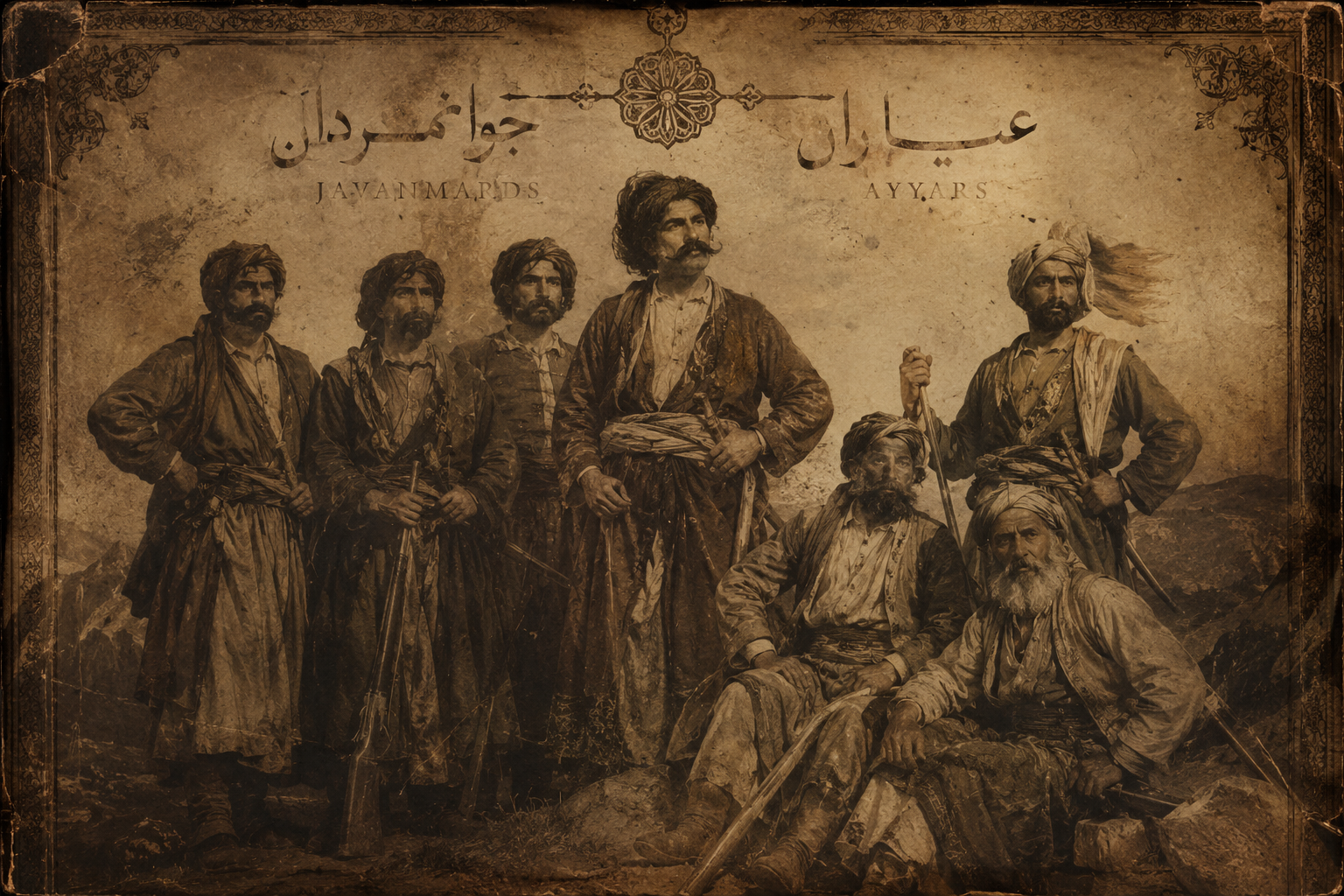
The essay’s central case study is the five-volume Parthian-origin prose epic Samak-e Ayyar, committed to writing under the Seljuqs in the twelfth century but internally dated to roughly two centuries into the common era. The romance follows Khorshid Shāh, the “Sun King,” and his pursuit of Mah Pari, the “Moon-faced” princess of China, accompanied by the Ayyar brotherhood led by Samak. Pourshariati reads the narrative frame itself — the sun’s journey east to overtake the moon — as a cosmological allegory rooted in Mithra’s own solar and covenantal character.
IV. Ethical and Ritual Parallels Documented in the Text
Drawing on extensive citation of the epic, Pourshariati documents a cluster of recurring practices among the Ayyars that she reads as a direct continuation of Mihr Yasht ethics:
- Entry into the brotherhood through spoken oath and contract (ʿahd), sworn specifically to Mithra, fire, and light — not to Ahura Mazdā.
- A wine-drinking ritual (“the cup of the men”) marking initiation, paralleling the krater and communal wine of Roman Mithraic ritual meals.
- A strict injunction to secrecy (rāz) regarding the affairs of one’s brethren.
- The obligation to grant refuge (zenhār) to the unjustly persecuted, mirroring Mithra’s own concern for the oppressed in the Mihr Yasht.
- A reciprocal code of loyalty — friend to one’s friends, enemy to one’s enemies — echoing the secondary sense of mithra as “friendship.”
- Nocturnal vigilance and swift, intelligence-gathering activity, paralleling Mithra’s sleeplessness and his thousand spies.
- Archery as the foremost martial discipline, with Samak himself renowned as one of the finest archers in the epic.
- The documented participation of women in the Ayyar associations — a feature Pourshariati notes as absent from Roman Mithraism and reserves for further study.
V. Closing Reflection
Pourshariati closes by situating this material within a broader, still largely unwritten history of Mithraic influence on Persianate literature — from the Shāhnāme to Hāfez — and frames the Ayyar material as the clearest available window onto what the ethics of pre-Islamic Iranian Mithraic brotherhoods may actually have looked like in practice. The address ends with a couplet from Nezāmi’s Makhzan al-Asrār, offered as a late literary echo of the same javanmardi ideal.
Source: Pourshariati, P. (2013). “The Ethics and Praxis of Mehr and Mithras and the Social Institution of the ʿayyārs in the Epic Romance of Samak-e ʿayyār.” Journal of Persianate Studies 6, 15–38.
Share This, Choose Your Platform!
Follow & Contact Us

We reestablish the Mithraic traditions. Subscribe now and stay in touch.