
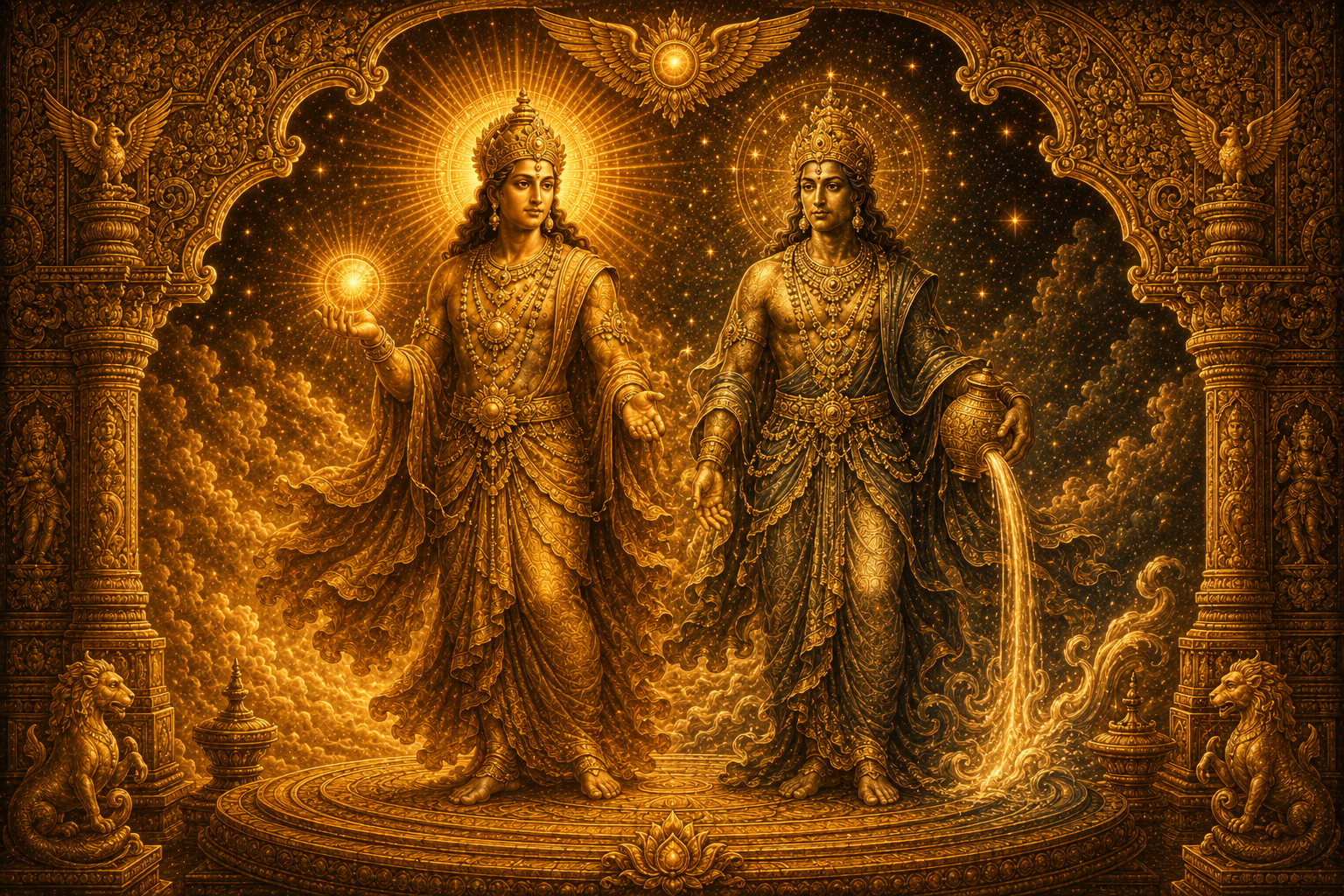
Mitra — Titles and Epithets
I. Royal and Sovereign Titles
Rājan — King. III.59.4: “Here Mitra, to be revered and very kind, has been born as a king of excellent dominion.” The kingship of Mitra is not military but relational and sanctioning — the authority of the sovereign who governs through the truth of the bond, not through force.
Rājan Sutrāman — King of Excellent Dominion / King of Outstanding Rule. III.59.4: the precise term used is “king of excellent dominion” (sutrāman or equivalent) — a title emphasizing the quality of his governance. It is a kingship characterized by order, benevolence, and the right placement of peoples within their relational structures.
Svarāj / Sovereign King — Used consistently in the dual with Varuṇa: “sovereign kings, powerful bulls, lords of heaven and of earth” (V.63.3); “sovereign kings, gods and lords” (VII.82.4); “youthful sovereign kings” (V.62). Mitra shares this title with Varuṇa but inflects it differently: where Varuṇa’s sovereignty is judicial, Mitra’s is the sovereignty of the acknowledged and maintained bond.
Rājan Ājānaḥ / King of Lifelong Rule — In the dual with Varuṇa: IV.42.1: “mine is the kingship of a lifelong ruler.” Mitra’s portion of this kingship is the primordial, enduring character of the alliance-principle — the bond between peoples is as old as human coexistence itself.
Mahān Āditya — The Great Āditya. III.59.5: “the great Āditya is to be approached with reverence.” Mitra is here designated the preeminent Āditya in the immediate context of this hymn, the one whose approach demands the highest reverence.
Rājan Dvijā — King, Twice-Born / King Born Here and Now. III.59.4 commentary: the hymn “marks the birth of an alliance, figured in verse 4 as the birth of Mitra himself at this time and in this place.” Mitra is not a remote cosmic principle but a god who is born anew every time an alliance is pronounced and acknowledged. His kingship is renewed with every bond.
II. Titles Relating to the Alliance and the Bond
Mitrá / God of Alliances — The most fundamental identity of the god. The etymology is philologically secure: mitrá designates the ally or the alliance. Mitra is the god whose name and function are structurally identical. Brereton & Jamison: “A mitrá was an ally or an alliance, and Mitra is the god of alliances.” He governs relationships defined by mutual obligations — and he is those relationships in their divine form.
Viśvasya Mitrá / Ally of All — The appellative sense of mitrá (“ally”) extends to encompass all relational domains. III.5.4 commentary: Agni is Mitra “the Mitra of the rivers and mountains” — an ally not only of humans but of all territorial and natural entities. The alliance principle is universal.
Adabdha Mitrá / Unerring Ally. I.94.13 (Agni identified as Mitra): “As a god, of the gods you are Mitra, the unerring ally.” The title adabdha — undeceivable, unerring, not to be misled — attaches here to Mitra’s function as ally. He is an ally who does not fail, does not deceive, does not deviate from the bond once made.
Mitrá Sakhā / Friend and Companion. The name itself — mitrá — carries the semantic field of friendship and companionship in addition to alliance. Mitra is the divine friend, the one whose presence among peoples makes cooperative coexistence possible. He is not merely a legal guarantor but the living quality of friendship between beings.
Mitrá Atithi / Kind Guest. III.5 commentary and verse 3: Agni is compared to Mitra specifically “because of his position on earth as guest and helper of men, though himself a god.” Mitra embodies the principle of the welcome guest — the one who crosses boundaries between groups and is received in trust. The sacred institution of hospitality is an expression of the mithraistic bond.
III. Titles Relating to Ordering Function
Janānāṃ Yatayitr̥ / Arranger of the Peoples. III.59.1: “Mitra arranges the peoples when Alliance is declared.” The verb √yat — to arrange, to place in order, to let take one’s rightful place — is the characteristic Mithraic verb, appearing consistently in III.59, V.65, and V.66. It names the specific action through which Mitra brings beings into their rightful relational positions.
Pṛthivyāḥ Dhartā / Upholder of Earth and Heaven. III.59.1: “Mitra upholds earth and heaven.” His binding function is not merely social but cosmological — the same power that holds alliances together upholds the cosmic structure.
Vibhaktā / Maintainer of the Separate Territories. III.59.6: “the god Mitra, who maintains the separate territories.” Mitra preserves the ordered spatial boundaries within which different peoples can coexist without conflict. He is a god of space as well as bond — he makes territory socially inhabitable.
Bhuvanasya Gopā / Guardian of the Living World. In the dual with Varuṇa: Mitra and Varuṇa together are guardians of the living world and all the peoples within it (I.41.1, VII.64.4: “Whom they guard — the attentive Varuṇa, Mitra, and Aryaman”). Mitra’s guardianship operates through the maintenance of the relational order that makes shared life possible.
Suhastagopā / Of Good Hands, Who Guards. I.136.9: “the kings Mitra and Varuṇa, they of good hands, who guard their own dear immortal thing within the cows.” The “good hands” designate the skilled, gentle, and reliable protection that Mitra extends — hands that hold and guard rather than bind and fetter.
IV. Titles Relating to Cosmic Scope and Power
Uruvyacas / Wide-Ranging. III.59.7: “Wide-ranging Mitra, who surmounts heaven through his greatness and earth through his renown.” His scope is cosmic — he exceeds the boundaries of any single people or territory. His ordering principle reaches to the furthest extension of the known world.
Sarvabhūtabhartā / He Who Bears All the Gods. III.59.8: “To Mitra with his power to dominate do the five peoples submit; he bears all the gods.” This is among the most striking of his titles — he sustains not only human communities but the divine order itself. The gods are upheld by the binding principle he embodies.
Virāj / He of Power to Dominate. III.59.8: “with his power to dominate.” Unlike Varuṇa’s domination through commandment and fetter, Mitra’s power operates through the acknowledged authority of the bond — peoples submit because they recognise the bond as true, not because they fear punishment.
Svarjit / He of Bright Renown. III.59.6–7: “his brilliance holds bright renown.” Mitra’s cosmic scope is expressed through the luminosity of his renown — he is known across all peoples and territories as the guarantor of the bond.
Rājan Dvijā / King Born at Every Alliance. III.59 commentary: “the birth of Mitra himself at this time and in this place.” Every time an alliance is pronounced, Mitra is born anew in it. His cosmic existence is not static but dynamically renewed through every act of binding.
V. Titles Relating to Truth and Cosmic Order
Ṛtāvān / Truth-Possessing. I.2.8: “o Mitra and Varuṇa, strong through truth, touching truth.” VII.66.4 and related passages: those “possessing the truth — Varuṇa, Mitra, and Agni.” Mitra possesses truth not in the sense of judicial enforcement but in the sense that the inner truth of a bond — its sincerity, its genuineness — is his domain.
Uccā Ṛtasya Gopā / Presider Over Lofty Truth. VI.1.9: “as Mitra does over lofty truth.” Mitra’s relationship to ṛta is characterized as one of oversight and governance — he presides over the highest form of truth operative in the relational domain of beings.
Mahagopā Ṛtasya / Great Herdsman of Truth. VII.64.3: “I will praise you, the great herdsmen of truth: Aditi, Mitra, Varuṇa.” As mahagopā ṛtasya Mitra tends truth the way a herdsman tends a herd — he keeps it alive, protects it from dissolution, and guides it through the relational space of human community.
Ṛtena Vardhamāna / Growing Through Truth. V.65.2: Mitra and Varuṇa are “lords of the settlement, who grow through the truth and possess the truth among every people.” Truth is not only what Mitra governs but what nourishes and strengthens him. His power increases wherever truth in relationship is upheld.
Satyakrama / He Whose Steps Are Set in Truth. Attested in contextual formulations: “For truth you have set your seven steps, begetting an alliance for…” (X.5.6). Mitra’s movement through the world is structured by truth — every act of alliance is a step of ṛta.
VI. Titles Relating to Wisdom and Cognitive Function
Kavi / Sage Poet / Inspired Seer. I.2.9: “the two sage poets, Mitra and Varuṇa, powerfully born, having a wide dominion.” Mitra is a kavi — not merely a divine power but a being of inspired cognitive depth. His alliance-making is not administrative but involves perception of the inner truth of relationships.
Dhiyaṃ Ghr̥ tācīm Āvahan / He Who Brings Success to Inspired Insight. I.2.7: “the poet calls on Mitra and Varuṇa who bring success to our ghee-covered insight (dhivaṃ ghṛtācīm).” Mitra actively empowers the dhī — the inspired visionary thought through which poets perceive and articulate cosmic truth. He is a patron and activator of the cognitive faculty of sacred insight.
Dhiyaḥ Sādhayitr̥ / Bringer of Success to the Insights of Singers. VII.60.12: “bring the insights of us singers to success, o Mitra.” The dhī of the ritual poet requires Mitra’s favour to reach its goal — he is the divine guarantor that inspired thought finds its completion and effect.
Jānant / The Knowing One. I.91.1: “With straight guidance let Varuṇa, let Mitra the knowing guide us.” Mitra is here designated explicitly as “the knowing one” — his guidance is not arbitrary authority but grounded in cognitive possession of what is right and true in the relational domain.
Mitrā ca Varuṇā Kavī / The Two Sage Poets. I.2.9: Mitra and Varuṇa together bear the title kavī — sage poets, inspired seers. For Mitra, this title identifies wisdom not as encyclopaedic omniscience (as for Varuṇa) but as relational discernment — the ability to perceive whether a bond is true, whether a relationship is in right order.
Mitra of Good Fellowship (Suvaryatas Mitra). III.5.3: “Mitra of good fellowship.” This title designates Mitra’s quality of mind in relationship — he who enters into fellowship rightly, whose inner orientation toward the bond is one of genuine, discerning goodwill.
VII. Titles Relating to Moral Character and Ethical Quality
Mitra Avyadhinī / He Who Never Does Injury. V.64.3: “the protection of Mitra, who never does injury.” This is the most ethically concentrated of all Mitra’s titles. It does not merely describe an absence of harm but characterizes the inner moral quality of his presence: to be under the protection of Mitra is to be in a space where injury does not occur, because the bond of genuine mutual acknowledgment precludes it.
Sumanas / Of Good Mind / Well-Disposed. Mitra is consistently associated with benevolent intention — “very kind to the one singing praise” (III.59.5), “very kind” (śreṣṭhatama). His mindset toward those who approach him rightly is inherently favourable.
Śreṣṭhatama / Most Wonderful / The Most Excellent. III.59.5: “For him the most wonderful, for Mitra, offer this pleasing offering.” This superlative designates the quality of his presence — among all the relational powers, Mitra is the most excellent, the one most worthy of approach.
Yajata / Worthy of Sacrifice. III.59.4: “him, who is worthy of the sacrifice.” Mitra deserves the highest ritual attention not because of his fearsome power but because of his essential role in making the reciprocal alliance between humans and gods possible.
Suvarcas / Of Bright Moral Lustre. The brilliance attributed to Mitra (III.59.6–7) is not merely physical luminosity but the radiance of his moral character — the clarity of right relationship shining through him.
VIII. Titles Relating to the Sacrificial Alliance
Devānāṃ Mitrá / Ally of the Gods / God of the Sacrificial Alliance. III.5 commentary and III.5.4: “Agni becomes Mitra when he is kindled. As the Hotar, he is Mitra.” Mitra is the deity of the sacrificial alliance between gods and humans — the covenant in which humans offer truth, hymns, and oblations, and the gods reciprocate by sustaining human life. Every sacrifice reconstitutes and renews the Mithraic bond between the human and divine orders.
Mitrá Devānāṃ Manuṣyāṇāṃ / Ally of Gods and Humans. The sacrificial alliance is explicitly reciprocal: “humans empower the gods through their praises and offerings, and the gods are expected to reciprocate by prospering humans” (III.59 commentary). Mitra is the divine principle that makes this reciprocity binding — without him the sacrifice would be a one-sided act rather than a true alliance.
Hotar / The Invoker. III.5.4: “As the Hotar, he is Mitra.” When Agni functions as the Hotar — the priest who invokes the gods and mediates between human and divine — he is functioning in Mitra’s capacity. Mitra is the divine model of sacred mediation and invocation.
Adhvaryumitrá / Ally in the Action of the Rite. III.5 commentary: “Agni’s identification with the Adhvaryu, the priest in charge of the action of the rite, follows from his role as Mitra.” Mitra’s alliance-principle governs not only external agreements between peoples but the internal structure of the sacrifice as a ritual alliance.
IX. Titles Relating to Space, Settlement, and Protection
Kṣetrasya Pati / Master of the Glory of the Settlements. VI.2.1: “You, o Agni, like Mitra are indeed master of the glory belonging to the settlements.” Mitra is the divine archetype of the lord who presides over a settled community — he ensures that the glory of the clan’s dwelling place is maintained through the network of alliances that make peaceful cohabitation possible.
Amitra / He Who Wins Broad Space from Narrow Straits. V.65.4: “Mitra then wins a broad way for peaceful dwelling, even out of narrow straits.” The title is functional rather than nominal but constitutive of Mitra’s spatial sovereignty: he is the one who creates room — social, physical, and existential — for those who live in right relationship.
Śarman Dā / Giver of Shelter. Mitra consistently appears among the gods who “extend shelter” to those who approach them rightly. I.41.1, V.64.3: “they go together with the protection of him who is dear, who never does injury.” His shelter is not the enclosure of a fortress but the open, protective space of a community held together by trust.
Śānti Mitra / Mitra of Peaceful Settlement. VII.82.5: “with peaceful settlement Mitra befriends Varuṇa.” This passage reveals a dimension rarely foregrounded: Mitra is not merely the guarantor of existing bonds but the active bringer of peace between those who are not yet at peace. He reconciles — even between gods.
Pitṛ / Father. VII.33.11: Mitra and Varuṇa are the divine fathers of Vasiṣṭha. As with Varuṇa, this establishes a generative, intimate dimension — Mitra is not only a social principle but a divine origin, a father who begets the lineage of wisdom and right relationship.
X. Titles Relating to Commandment and Sanction
Vrata-dhārayitr̥ / Of Steadfast Commandments. I.23.6: “o Mitra and Varuṇa of steadfast commandments.” Mitra’s commandments are not the external impositions of Varuṇa’s vrata but the binding norms inherent in the bond itself — what is owed to one another by those who have entered into mutual obligation.
Prajā-rājñī / He Whose Commandments Are Desirable. III.59.9: “Mitra has created refreshments that carry his desirable commandments.” Where Varuṇa’s commandments are feared, Mitra’s are desired — they are experienced not as constraint but as the welcome structure of a life lived in right relationship.
Rājan Blazing Commandments (Citraśrut). In the dual with Varuṇa: VII.66.35: “the two kings of blazing commandments.” For Mitra, the blazing quality of the commandment is not punitive fire but the luminous clarity of the bond’s binding force.
Varuṇa — Titles and Epithets
I. Royal and Sovereign Titles
Rājan — King. The most fundamental and pervasive title of Varuṇa, used repeatedly in direct address: “King Varuṇa” (I.24.13, I.25.14, IV.42.1–2). His kingship is not military but judicial and cosmic — the authority of the sovereign who governs by command, truth, and the power to bind and release.
Rājan Viśvasya Bhuvanasya — King of the Whole Living World. V.85.3: “By this he is king of the whole living world.” VII.87.6: “the king of what is.” VIII.42.10: “You are the king of all, Varuṇa, both gods and mortals, o lord.” His sovereignty is not tribal or regional but totalizing — it encompasses every living being in the cosmos.
Rājan Rājānām — King of Kings. VIII.41.11: “King of kingdoms.” This superlative title places Varuṇa above all earthly sovereigns as their divine archetype and cosmic superior.
Rājan Ājānaḥ — King of Lifelong / Primordial Rule. IV.42.1: “Mine is the kingship of a lifelong ruler, so that all the immortals are ours.” His sovereignty is not acquired or conditional but primordial and without end.
Svarāj — Self-Ruler / Autonomous Sovereign. IV.42.1–2: “the gods follow the will of Varuṇa.” Varuṇa rules not by delegation or consent but by inherent cosmic authority. Even the gods are subject to his will.
Kṣatriya / Sovereign King — Used in the dual with Mitra: “sovereign kings, powerful bulls, lords of heaven and of earth” (V.63.3); “sovereign kings, gods and lords” (VII.82.4); “youthful sovereign kings” (V.62). As the more prominent of the two, Varuṇa sets the tone of this sovereignty.
Dharmapati — Lord of Dharma. IV.42 commentary: the king is compared to Varuṇa as dharmapati. This title places Varuṇa as the divine foundation of all normative order — cosmic, social, and moral.
Asura — Mighty Lord. Used in the archaic vedic sense of supreme divine power — not the later demonic connotation. V.63.3 commentary: Mitra and Varuṇa are called asura, connecting their ability to control rain to their status as cosmic lords. Varuṇa is the preeminent bearer of this title among the Ādityas.
II. Titles Relating to Commandment and Cosmic Law
Vratapati / God of Commandments — Varuṇa’s name is etymologically related to vrata (“commandment, binding order”). He is constitutively the god whose nature is the commandment. The moon and stars appear according to his commandment (I.24.10); the rivers flow according to his commandment (II.28.4); the sun’s path is established by his commandment. All cosmic regularity is an expression of vrata.
Dhṛta-vrata — Of Upheld / Steadfast Commandments. “Varuṇa whose commandments are upheld” (I.151, VI.68.5). His commandments are not provisional but inviolable and enduring.
Vrata-dhārayitr̥ — Upholder of Commandments. He is the one who maintains the structure of binding order against all transgression and dissolution.
Rājan Aditeḥ Vrata — King Within the Commandments of Aditi. VII.86.7: “we would be within Varuṇa… as we obediently fulfill the commandments of Aditi.” To be “within Varuṇa” is to be in conformity with the binding order of cosmic offenselessness. Brereton & Jamison note the deliberate wordplay: váruṇe (“within Varuṇa”) echoes vrata (“commandment”) — to be inside Varuṇa is to be inside the law itself.
III. Titles Relating to Cosmic Architecture and Creation
Kavítama / Nirmātṛ — Foremost Sage Poet and Cosmic Measurer. V.85: Varuṇa is explicitly named kavítama — “the foremost sage poet, the one who best knows and best articulates what he knows.” He “standing in the midspace as if with a measuring rod, measured out earth with the sun.” He is both the supreme knower and the divine architect who establishes cosmic dimensions. (See Section V for the full wisdom dimension of this title.)
Viśvakarmā — All-Maker / Creator of Cosmic Structure. V.85.1–2: Varuṇa “split apart the earth to form an underlayer for the sun,” “stretched out the midspace upon the trees,” “placed resolve in hearts, fire in waters, the sun in heaven, and soma on the stone.” VII.87.1: “Varuṇa dug the paths for the sun.” VII.88.5: “The clever King Varuṇa created this, the golden swing in heaven [=the sun].” He is the structuring intelligence behind the physical cosmos.
Rājan Uru Pathā — King Who Made the Broad Path for the Sun. I.24.8, V.85.2, VII.87.1: Varuṇa establishes the sun’s path across the sky. The ordered transit of the sun is an expression of his sovereign will.
Rājan Ā́ditya — King, Son of Aditi. Varuṇa is the foremost of the Ādityas — “the greatest of the Ādityas” (I.35 commentary). As son of Aditi (“offenselessness”), he embodies the cosmic principle of freedom from transgression. IV.42.4: “the son of Aditi possesses the truth.”
Rajanī-pati / Lord of the Night Sky. Though not a fixed title, Varuṇa’s rule over the night and the stars is constitutive. The stars appear and disappear according to his commandment (I.24.10). His garment is truth, but his domain encompasses the night.
IV. Titles Relating to Omniscience and Surveillance
Sahasrākṣa — Of a Thousand Eyes. VIII.41.10: “powerful Varuṇa of a thousand eyes.” His omniscient surveillance extends over all beings and all actions simultaneously — an image of totalizing cosmic awareness that no transgression can escape.
Spāśavat — Possessor of Spies (Spāśaḥ). I.25.13: Varuṇa watches over his subjects by means of his spāśaḥ — divine agents of surveillance distributed throughout the cosmos. His omniscience is not merely personal but structurally distributed: he sees through agents embedded in the world itself.
Cakṣus / Goptā Sūrya — The Eye / He Who Sees Through the Sun. I.115.1, VII.61.1, VII.63.1: The Sun is “the eye of Mitra and Varuṇa.” Varuṇa sees through the solar transit itself — the movement of the sun across the sky is an act of divine moral surveillance. VII.49.3: “King Varuṇa travels in the middle of the waters, looking down upon the truth and untruth of human beings.”
Sarvajña — Knower of All Things. V.65.3: “Because all of them — Varuṇa, Mitra, and Aryaman — know all things, they follow their commandments like tracks.” Varuṇa’s omniscience is not merely surveillance but total cognitive possession of reality — he knows because he is the order he governs.
Acyuta / Undeceivable. I.25 commentary and verse: Varuṇa is repeatedly designated as ádabdha — undeceivable, not to be tricked or misled. No false claim, no ritual formality without inner truth, can satisfy him. He perceives the inner state directly.
V. Titles Relating to Wisdom and Inspired Knowledge
Kavítama — The Foremost Sage Poet / Supreme Knower. V.85 commentary: Varuṇa is “the foremost sage poet, the one who best knows and best articulates what he knows.” This is the most philosophically concentrated of all his titles. It establishes that Varuṇa’s sovereignty is not arbitrary power but grounded in supreme cognitive possession of reality. He commands because he knows. He governs because he comprehends the structure of what is.
Kavi — Inspired Seer / Sage Poet. I.2.9: Mitra and Varuṇa together are “the two sage poets, powerfully born, having wide dominion.” As kavi, Varuṇa does not merely command but perceives — his authority is grounded in visionary insight into the nature of things.
Medhira — The Wise One / He Who Imparts Wisdom. VII.88.4: Varuṇa speaks to the poet “who am wise.” Brereton & Jamison identify the deliberate ambiguity: either Varuṇa recognizes that the poet is wise, or his words themselves make the poet wise. Either reading establishes Varuṇa as simultaneously the judge of wisdom and its source. He does not merely reward the wise — he produces wisdom in those who approach him rightly.
Bodhayitr̥ / Enlightener. VII.88 commentary: “Varuṇa has enlightened Vasiṣṭha.” This is one of the most theologically significant statements in the Rigveda regarding Varuṇa. The encounter between poet and god does not end in punishment or release alone — it ends in enlightenment. Varuṇa transmits understanding that transforms the one who receives it.
Goptā Dhiyām — Guardian of Insights / Protector of Human Mental Vision. VIII.42.1: Varuṇa “guards the insights (dhī) of the sons of Manu like the cows of a herd.” The dhī — the inspired, visionary thought through which humans perceive cosmic order — is kept safe under Varuṇa’s protection. He does not only judge human action; he custodians the very faculty through which humans can access ṛta at all.
Medhāvin / Insightful Herdsman of the Immortal. VIII.42.2: “Offer reverence to the insightful herdsman of the immortal.” Varuṇa tends human dhī the way a herdsman tends his flock — guiding, protecting, orienting human insight toward the immortal order. The metaphor is striking: wisdom is a living thing that requires tending, and Varuṇa is its divine shepherd.
Gūḍhavācin — He Who Speaks in Secrets / Cryptic Speech. VII.88.4: Varuṇa speaks hidden, cryptic words — “he will speak their names like secrets.” His wisdom is not fully communicable in ordinary language; it is esoteric, transmitted only to those capable of receiving it. This places Varuṇa among the most mysteriously wise figures in the Rigveda — a god whose knowledge exceeds what can be straightforwardly articulated.
Dīrghaśrut / He of Deep Recitation. VII.88.6: Varuṇa is described as one “of deep recitation.” Brereton & Jamison note the ambiguity: Varuṇa both speaks profound words and inspires profound speech in others. His wisdom is generative — it produces wisdom in those who approach him. He is simultaneously the source and the activator of inspired knowledge.
VI. Titles Relating to Moral and Judicial Authority
Ṛtāvān — Possessor of Truth / Truth-Possessing. Varuṇa is repeatedly addressed as ṛtāvān — his judicial authority derives not from power alone but from his essential identity with ṛta. I.25.6: “o truth-possessing one.” He does not merely enforce truth from outside; he is its possessor.
Pāśin — Wielder of the Fetter (Pāśa). The pāśāḥ — the fetters or nooses — are the most feared instrument of Varuṇa’s justice. I.24.15, I.25.21: he “binds those who violate his commandments.” The fetter is not merely punitive but cosmic: it binds the transgressor to the inescapable consequences of violated order. The bond cannot be escaped — only released by Varuṇa himself.
Ripughna / Confounders of Untruth. Varuṇa and Mitra “took untruth away from truth by their own power” (I.152.2) and are the “avengers of much untruth” (VII.66.4). Varuṇa is the active destroyer of falsehood — not a passive judge but an agent who pursues and eliminates anṛta.
Dharmasākṣin — Witness of Dharma / Observer of Moral Conduct. IV.42 commentary: “as Varuṇa, the king is a judicial authority governing the actions of his subjects.” The Vasiṣṭha hymns portray Varuṇa as intimately aware of every human offense. He observes not the surface of action but its moral interior.
Ṛtadhāman — He Whose Seat is Truth. V.66.2: Mitra and Varuṇa “grow through the truth and possess the truth among every people.” Varuṇa’s authority is not arbitrary: it is seated in and sustained by ṛta itself.
VII. Titles Relating to Mercy, Liberation, and Atonement
Kṣamāśīla / The Merciful. VII.88.7: Varuṇa “will have mercy even on him who has committed an offense.” I.25.19: “Varuṇa, have mercy.” Despite the fearsome apparatus of his justice — spies, fetters, disease — Varuṇa is equally the god to whom the penitent turns for compassion. His mercy is not weakness but the sovereign prerogative of the one who alone can release what he has bound.
Mocana / The Liberator. I.24.15: “Loosen above the uppermost fetter from us, o Varuṇa, below the lowest, away the midmost.” He alone can unbind what he has bound — making him simultaneously judge and liberator. The asymmetry is total: no one else can release Varuṇa’s fetter. Only Varuṇa can.
Kṣamāpati / Lord of Forgiveness. The Vasiṣṭha-Varuṇa hymns (VII.86–88) constitute the most intimate theological encounter in the Rigveda: a poet confessing his offense, and Varuṇa — the sovereign of cosmic justice — extending forgiveness, then enlightenment. This dimension establishes Varuṇa as the divine mediator between guilt and liberation, between transgression and restored order.
Bhiṣaj / Physician — He of a Hundred Healers. I.25.9: “A hundred healers are yours, o king, a thousand.” Varuṇa’s punitive power extends to disease — dropsy in particular is associated with his displeasure. But the same verse that invokes his power over disease immediately asks for its removal. He is both the cause and the cure — physician and the affliction he can heal.
VIII. Titles Relating to the Waters and Cosmic Fertility
Sindhuḥpati / Samudrapati — Lord of the Rivers / Lord of the Ocean. II.28.4: rivers flow according to his commandment. VIII.41: he is “ornament of the rivers.” He travels “through the waters and seas” (I.25). His sovereignty over water makes him the guarantor of cosmic fertility and agricultural abundance.
Parjanyadhipati — Controller of Rain. V.85.3–4: “The divine king Varuṇa brings rain.” His control over rain connects moral order to natural abundance — those who stand in his favour receive rain; those who violate his commandments find the waters withheld.
Ṛtavasana — Whose Garment is Truth. V.66.1: “It should be set in place for Varuṇa, whose garment is the truth.” Unlike the warrior god who wears armour, Varuṇa is clothed in ṛta itself — truth is not an instrument he wields but the very fabric of his being.
IX. Titles Relating to Cosmic Intimacy and Encompassment
Antaryāmin / He Within Whom One Dwells. VII.86.2: “When shall I be within Varuṇa?” VII.87.7: “we would be within Varuṇa.” To be within Varuṇa — váruṇe — is to be in conformity with the cosmic commandment. Brereton & Jamison note the deliberate etymological play on vrata: the interior of Varuṇa is the interior of the law itself. This makes Varuṇa uniquely encompassing among the vedic gods: he is not only a power one petitions from outside, but a state one can inhabit from within.
Pitṛ / Father. VII.33 and commentary: Varuṇa (together with Mitra) is named as the father of Vasiṣṭha. This is not merely mythological but establishes a dimension of intimate, generative relationship — Varuṇa as the divine origin of the priestly lineage, the god who begets wisdom through relationship.
Contrast of the Titles and Epithets
| Domain | Mitra | Varuṇa |
|---|---|---|
| I. Royal & Sovereign Titles | ||
| King | Rājan — King of relational sovereignty; governs through the bond, not force. III.59.4 | Rājan — King of judicial and cosmic authority; governs by command and truth. I.24.13, I.25.14, IV.42.1–2 |
| Quality of rule | Rājan Sutrāman — King of excellent dominion; order, benevolence, right placement of peoples. III.59.4 | Rājan Rājānām — King of kings; divine archetype above all earthly sovereigns. VIII.41.11 |
| Scope of rule | Svarāj — Sovereign king (shared); inflected as sovereignty of the acknowledged bond. V.63.3, VII.82.4 | Rājan Viśvasya Bhuvanasya — King of the whole living world; totalizing, every being subject. V.85.3, VII.87.6, VIII.42.10 |
| Primordial rule | Rājan Ājānaḥ — King of lifelong rule; the bond is as old as human coexistence. IV.42.1 dual | Rājan Ājānaḥ — King of primordial rule; sovereignty not acquired but inherent and without end. IV.42.1 |
| Divine birth | Rājan Dvijā — King born here and now; reborn with every alliance pronounced. III.59.4 commentary | Rājan Āditya — King, son of Aditi; greatest Āditya, embodiment of offenselessness. I.35 commentary, IV.42.4 |
| Unique sovereign | Mahān Āditya — The great Āditya; preeminent in the context of III.59. III.59.5 | Svarāj — Self-ruler; gods themselves follow the will of Varuṇa. IV.42.1–2 |
| Law and order | — not applicable to Mitra | Dharmapati — Lord of dharma; divine foundation of all normative order. IV.42 commentary |
| Cosmic lord | — not Mitra’s primary register | Asura — Mighty lord; archaic supreme divine power (pre-demonic usage). V.63.3 commentary |
| II. Commandment & Law | ||
| Nature of commandment | Vrata-dhārayitr̥ — Of steadfast commandments; binding norms inherent in the bond itself. I.23.6 | Vratapati — Lord of commandments; cosmic regularity as expression of vrata. Etymological; I.24.10, II.28.4 |
| Quality of commandment | Prajā-rājñī — He whose commandments are desirable; welcomed, not feared. III.59.9 | Dhṛta-vrata — Of upheld commandments; inviolable and enduring. I.151, VI.68.5 |
| Blazing commandments | Citraśrut [shared] — Luminous clarity of the bond’s binding force. VII.66.35 dual | Citraśrut [shared] — Punitive fire of the cosmic law; blazing sanction. VII.66.35 dual |
| Law as dwelling | — not Mitra’s register | Rājan Aditeḥ Vrata — To be within Varuṇa is to be within the law; deliberate wordplay on vrata. VII.86.7 commentary |
| III. Ordering Function | ||
| Arranger of peoples | Janānāṃ Yatayitr̥ — Arranger of the peoples; characteristic verb √yat, placing beings in right relation. III.59.1, V.65, V.66 | — Varuṇa binds from outside; does not use √yat |
| Upholder of cosmos | Pṛthivyāḥ Dhartā — Upholder of earth and heaven; the bond-power sustains cosmic structure. III.59.1 | Viśvakarmā — All-maker; architect of cosmic structure; split earth, set sun’s path. V.85.1–2, VII.87.1, VII.88.5 |
| Territories | Vibhaktā — Maintainer of the separate territories; space made socially inhabitable. III.59.6 | Rājan Uru Pathā — King who made the broad path for the sun; cosmic spatial architect. I.24.8, V.85.2, VII.87.1 |
| Guardian | Bhuvanasya Gopā — Guardian of the living world; through maintenance of relational order. I.41.1, VII.64.4 | Rajanī-pati — Lord of the night sky; stars appear and disappear by his commandment. I.24.10 |
| Gentle hands | Suhastagopā — Of good hands, who guards; hands that hold and guard, not bind. I.136.9 | — Varuṇa’s hands bind; his is the fetter, not the open palm |
| IV. Cosmic Scope & Power | ||
| Cosmic reach | Uruvyacas — Wide-ranging; surmounts heaven through greatness, earth through renown. III.59.7 | Sahasrākṣa — Of a thousand eyes; totalizing omniscient surveillance. VIII.41.10 |
| Bears divine order | Sarvabhūtabhartā — He who bears all the gods; the bond-principle sustains the divine order itself. III.59.8 | — Varuṇa commands the gods; he does not bear them |
| Mode of power | Virāj — Power to dominate; through acknowledged authority of the bond. III.59.8 | Spāśavat — Possessor of spies; omniscience distributed through the cosmos. I.25.13 |
| Renown / measure | Svarjit — He of bright renown; known as guarantor of the bond across all peoples. III.59.6–7 | Nirmātṛ — Cosmic measurer; standing in midspace with measuring rod. V.85.5 |
| V. Truth & Cosmic Order | ||
| Truth-possessing | Ṛtāvān [shared] — Inner truth of the bond; sincerity and genuineness in relationship. I.2.8, VII.66.4 | Ṛtāvān [shared] — Judicial authority from essential identity with ṛta. I.25.6 |
| Presider over truth | Uccā Ṛtasya Gopā — Presider over lofty truth; governs the highest relational form of truth. VI.1.9 | Ṛtadhāman — He whose seat is truth; authority seated in and sustained by ṛta. V.66.2 |
| Herdsman of truth | Mahagopā Ṛtasya [shared] — Tends truth in the relational space of human community. VII.64.3 | Mahagopā Ṛtasya [shared] — Tends truth as the framework of cosmic and moral order. VII.64.3 |
| Growth through truth | Ṛtena Vardhamāna [shared] — Power increases where truth in relationship is upheld. V.65.2 | Ṛtena Vardhamāna [shared] — Cosmic authority nourished by ṛta. V.65.2 |
| Steps / garment of truth | Satyakrama — He whose steps are set in truth; every alliance a step of ṛta. X.5.6 | Ṛtavasana — Whose garment is truth; truth is the very fabric of his being. V.66.1 |
| Defeats untruth | Ripughna [shared] — Confounder of untruth in the domain of broken bonds. I.152.2, VII.66.4 | Ripughna [shared] — Active destroyer of anṛta; pursues and eliminates cosmic falsehood. I.152.2, VII.66.4 |
| VI. Wisdom & Cognitive Function | ||
| Sage poet | Kavi [shared] — Relational discernment; perceives whether a bond is true and in right order. I.2.9 | Kavítama — Foremost sage poet; supreme cognitive possession of reality; commands because he knows. V.85 commentary |
| The knowing | Jānant — The knowing one; guidance grounded in knowledge of right relation. I.91.1 | Sarvajña — Knower of all things; total cognitive possession of reality. V.65.3 |
| Patron of insight | Dhiyaṃ Ghr̥tācīm Āvahan — Invoked to ensure the poet’s dhī reaches its goal and becomes effective; does not originate insight but guarantees its completion. I.2.7 | Goptā Dhiyām — Guardian of insights; custodian of the human faculty of sacred vision. VIII.42.1 |
| Success of insight | Dhiyaḥ Sādhayitr̥ — Brings the insights of singers to their completion and effect; ensures dhī lands in the relational order it was meant to illuminate, not that he produces or originates it. VII.60.12 | Medhāvin — Insightful herdsman of the immortal; tends dhī toward the divine order. VIII.42.2 |
| Good fellowship / wisdom | Suvaryatas Mitrá — Mitra of good fellowship; genuine, discerning goodwill in relationship. III.5.3 | Medhira — The wise one; judge of wisdom and its source; makes the poet wise. VII.88.4 |
| Enlightener | — No direct connection attested in the Rigveda. Mitra is invoked to bring the insights of singers to their completion (VII.60.12) but does not transmit or produce wisdom in another being. That function belongs to Varuṇa alone. | Bodhayitr̥ — The enlightener; Varuṇa has enlightened Vasiṣṭha; transmits transforming understanding. VII.88 commentary |
| Esoteric speech | — Mitra speaks through the bond, not cryptic revelation | Gūḍhavācin / Dīrghaśrut — He who speaks in secrets / of deep recitation; wisdom not fully communicable in ordinary language. VII.88.4, VII.88.6 |
| Undeceivable | Adabdha Mitrá — Unerring ally; does not fail, deceive, or deviate from the bond. I.94.13 | Acyuta — Undeceivable; perceives inner states directly; no false claim satisfies him. I.25 commentary |
| VII. Moral Character & Ethical Quality | ||
| Non-injury | Avyadhinī — He who never does injury; genuine acknowledgment precludes harm. V.64.3 | — Varuṇa binds and afflicts; non-injury is not his register |
| Kindness / mercy | Sumanas / Śreṣṭhatama — Of good mind / most wonderful; inherently favourable to those who approach rightly. III.59.4–5 | Kṣamāśīla — The merciful; sovereign prerogative: shows mercy even on the offender. VII.88.7, I.25.19 |
| Witness | — Mitra’s moral gaze is the bond’s inner truth, not judicial witness | Dharmasākṣin — Witness of dharma; observes the moral interior, not the surface of action. IV.42 commentary |
| Moral lustre | Suvarcas — Of bright moral lustre; clarity of right relationship shining through him. III.59.6–7 | — Varuṇa’s brilliance is cosmic luminosity, not primarily moral |
| Worthy of sacrifice | Yajata — Worthy of sacrifice; for his role in the reciprocal human-divine alliance. III.59.4 | — Varuṇa is approached with reverence, not primarily framed as yajata |
| VIII. Alliance & Bond | ||
| God of alliances | Mitrá — God of alliances; name and function structurally identical; he is the alliance. III.59, B&J etymology | Pāśin — Wielder of the fetter; binds the transgressor to inescapable consequences. I.24.15, I.25.21 |
| Ally of all | Viśvasya Mitrá — Ally of all; rivers, mountains, all territories; alliance principle is universal. III.5.4 commentary | — Varuṇa commands all; he does not enter alliance with all |
| Friend | Mitrá Sakhā — Friend and companion; living quality of friendship between beings. Semantic field of mitrá | Pitṛ [shared] — Father of Vasiṣṭha; generative, intimate divine origin of priestly lineage. VII.33 commentary |
| Guest | Mitrá Atithi — Kind guest; crosses boundaries between groups and is received in trust. III.5 commentary | — Varuṇa is petitioned, not received as guest |
| IX. Sacrificial Alliance | ||
| Sacrificial deity | Devānāṃ Mitrá — God of the sacrificial alliance; every sacrifice renews the Mithraic covenant. III.5 commentary, III.5.4 | — Varuṇa receives soma; he does not constitute the alliance structure |
| Priestly function | Hotar / Adhvaryumitrá — The invoker; divine model of sacred mediation; Agni becomes Mitra when kindled. III.5.4 | — Varuṇa is the object of invocation, not its divine model |
| Reciprocity | Mitrá Devānāṃ Manuṣyāṇāṃ — Ally of gods and humans; makes the reciprocal sacrifice binding. III.59 commentary | — Varuṇa commands the exchange; Mitra constitutes it |
| X. Mercy & Liberation | ||
| Mercy | — Mitra’s protection is inherently non-injurious; mercy is not a separate act | Kṣamāśīla — The merciful; sovereign prerogative of the one who alone can release the fetter. VII.88.7, I.25.19 |
| Liberator | — Mitra does not bind; there is nothing to release | Mocana — The liberator; he alone unbinds what he bound; simultaneous judge and liberator. I.24.15 |
| Forgiveness | — not Mitra’s domain | Kṣamāpati — Lord of forgiveness; Vasiṣṭha hymns: from transgression to forgiveness to enlightenment. VII.86–88 |
| Healer | — disease is not Mitra’s instrument | Bhiṣaj — Physician, he of a hundred healers; both cause and cure of affliction. I.25.9 |
| XI. Space & Settlement | ||
| Lord of settlements | Kṣetrasya Pati — Master of the glory of the settlements; presides over clan’s dwelling through alliances. VI.2.1 | Sindhuḥpati / Samudrapati — Lord of rivers and ocean; rivers flow by his commandment. II.28.4, VIII.41, I.25 |
| Broad space | Amitra (functional) — He who wins broad space from narrow straits; through right relationship. V.65.4 | Parjanyadhipati — Controller of rain; moral order expressed in natural abundance or drought. V.85.3–4 |
| Shelter | Śarman Dā — Giver of shelter; open protective space of community held together by trust. I.41.1, V.64.3 | Antaryāmin — He within whom one dwells; to be within Varuṇa is to be within the law itself. VII.86.2, VII.87.7 |
| Peacemaker | Śānti Mitrá — Mitra of peaceful settlement; active bringer of peace; reconciles even gods. VII.82.5 | — Varuṇa commands order; he does not reconcile |
| Father | Pitṛ [shared] — Father of Vasiṣṭha; begets the lineage of wisdom and right relationship. VII.33.11 | Pitṛ [shared] — Father of Vasiṣṭha; generative, intimate divine origin of priestly wisdom. VII.33 commentary |
| XII. Waters & Fertility (Varuṇa only) | ||
| Waters | — water is not Mitra’s domain | Sindhuḥpati — Lord of rivers and ocean; sovereignty over the waters, fertility and abundance. II.28.4, VIII.41, I.25 |
| Rain | — not Mitra’s domain | Parjanyadhipati — Controller of rain; moral order made visible in natural abundance or drought. V.85.3–4 |
| Truth as garment | — not expressed for Mitra in this form | Ṛtavasana — Whose garment is truth; truth is not an instrument but the fabric of his being. V.66.1 |
Disclaimer
All references to the Rigveda are based on the work of Jamison, S. W., & Brereton, J. P. (Translators). (2014). The Rigveda: The earliest religious poetry of India (Vols. 1–3). Oxford University Press.
This post was created with the assistance and structural refinement of AI.
Share This, Choose Your Platform!
Follow & Contact Us


We reestablish the Mithraic traditions. Subscribe now and stay in touch.