
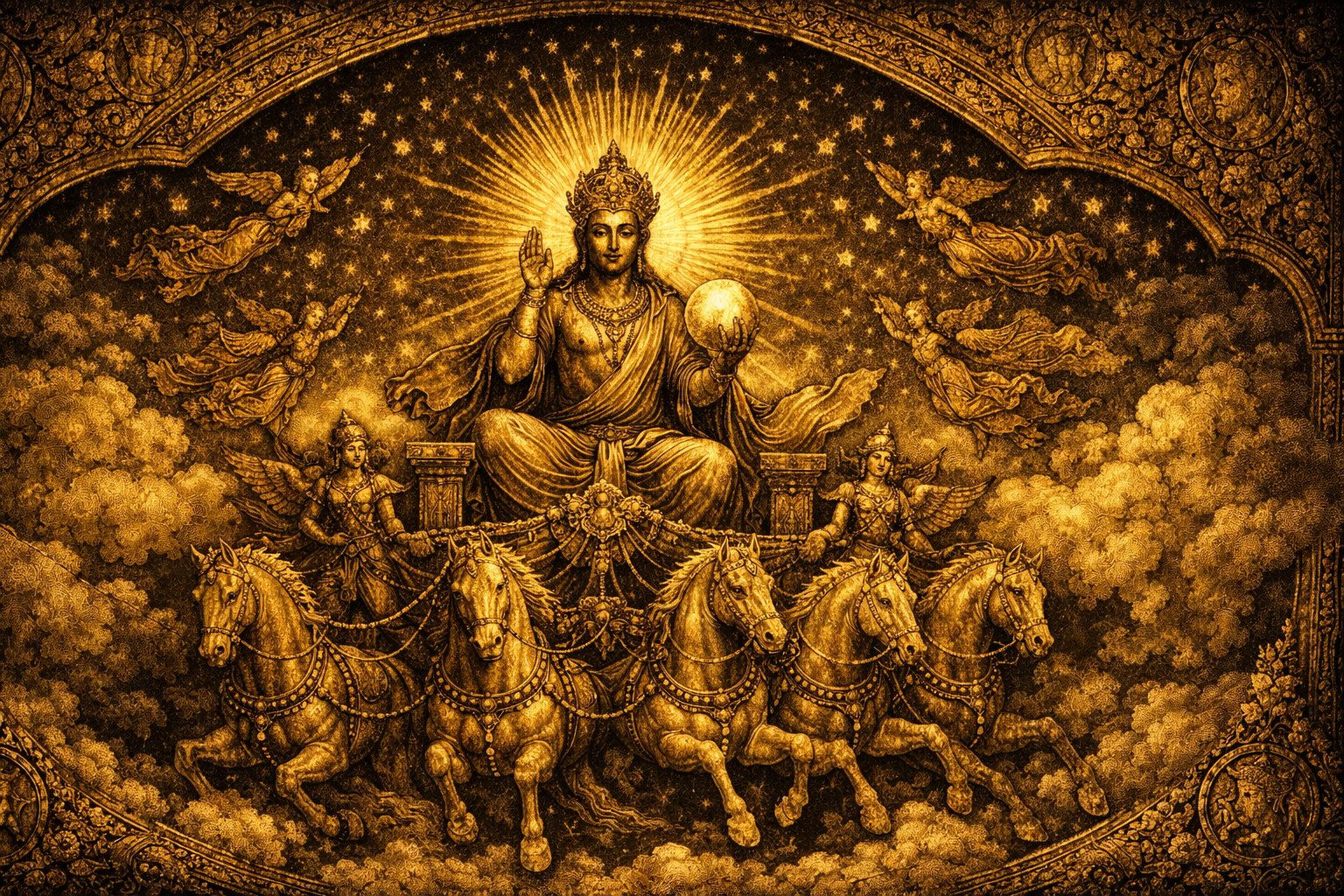
The question of whether Maitreya was influenced by Mithra cannot be answered with absolute proof in the strict historical sense. There is no surviving text that says, in so many words, “the Buddhist Maitreya was created from the Iranian Mithra.” But the cumulative evidence points in one direction strongly enough to support a serious thesis: the Buddhist figure of Maitreya very likely took shape, at least in part, within an Indo-Iranian religious environment already saturated with the older Mithra-complex. The relationship is not one of simple identity, and Maitreya is not merely “Mithra renamed.” Yet the overlap in name, semantic field, geography, cultic function, and iconographic environment is too substantial to dismiss as coincidence.
Disclaimer: This essay was refined structurally by AI.
Arguments
The first level of the argument is philological. In the Indo-Iranian world, the name Mitra/Mithra is tied to the semantic field of contract, covenant, alliance, promise, and social bond. Encyclopaedia Iranica summarizes the name of the Indo-Iranian god as deriving from the common noun mitrá, “contract,” with connotations such as agreement, treaty, alliance, and promise. In Vedic religion, Mitra represents friendship, harmony, integrity, and the maintenance of human order; he is the divine force behind trust and proper relation. By contrast, the Buddhist name Maitreya is conventionally explained from Sanskrit maitrī, “friendliness,” itself related to mitra, “friend.” Even before one reaches theology, then, the linguistic field is already shared: bond, friendship, benevolence, social trust, relational harmony. Maitreya’s very name preserves the core semantic charge that belongs to Mitra/Mithra.
This does not by itself prove influence. Words can resemble each other without requiring borrowing. But here the resemblance is not merely phonetic. It is semantic and religious. The old Vedic Mitra is not just a god whose name sounds like Maitreya; he is a figure of friendship, agreement, order, and right relation. The Buddhist Maitreya is not simply a future Buddha with a similar syllabic form; he is explicitly the figure of friendliness, expectancy, and beneficent future presence. That is already enough to justify asking whether Buddhism, especially in the northwest, transformed an old Indo-Iranian divine quality into a Buddhist savior-figure.
The second level is historical geography. Maitreya devotion did not arise in isolation from Iran. Buddhism spread through Bactria, Gandhāra, Sogdia, and adjacent regions, that is, through lands deeply connected with Iranian-speaking populations and Iranian religious traditions. Encyclopaedia Iranica notes that Buddhism was established among Iranian peoples in Central Asia and Afghanistan, while Gandhāran art itself was shaped in substantial part by Iranian contribution. This matters because Maitreya’s rise as a cultic and artistic figure is especially strong in the very regions where Buddhist, Iranian, Hellenistic, and Central Asian forms met. The issue is not whether Buddhism and Iranian religion ever touched; they clearly did. The issue is whether the specific figure of Maitreya emerged in a zone where Iranian concepts could shape Buddhist imagination. The answer is yes.
At this point the evidence becomes more pointed. Jonathan Silk’s survey of Maitreya in Brill’s Encyclopedia of Buddhism states that the title “Maitreya the Invincible” led earlier scholars such as Przyluski, Lévi, and Filliozat to suggest origins in Northwest India, in particular in relation to the Iranian god Mithra, compared with Sol Invictus. Silk is careful: he says the theory is not universally accepted, but also that it is not without merit. That is important. Serious scholarship has not treated the Mithra–Maitreya connection as fantasy; it has treated it as a debated but plausible hypothesis.
The strongest single piece of evidence in that same discussion is Bamiyan. Silk notes that the great mural on the ceiling of the alcove of the eastern Buddha at Bamiyan contains the sun god Mithra in a flying chariot, while the western Buddha’s vault mural is centered on a seated Maitreya surrounded by the beings of Tuṣita heaven. This juxtaposition is extraordinary. It does not prove that Maitreya “came from” Mithra in a linear, one-step derivation, but it shows that in late antique Afghanistan the two belonged to a shared symbolic world. Mithra could occupy the cosmic-luminous ceiling of one monumental Buddha, while Maitreya occupied the corresponding eschatological-heavenly place of another. In other words, the religious imagination of the region did not see these figures as alien to one another. It could think them together.
A further argument comes from distribution. Silk remarks that in Gandhāra Maitreya imagery is extraordinarily abundant, far more so than in Mathurā, and that Maitreya imagery in Gandhāra became second only to representations of the Buddha. If Maitreya’s development were purely internal to mainstream Indian Buddhism, one might expect a more even distribution. Instead, his visual prominence is intensified precisely in the northwestern contact zone. That does not prove Iranian origin, but it fits the thesis that northwestern Buddhism gave special form and energy to the Maitreya figure, and that this happened where Iranian cultural presence was strong.
There is also a structural argument. Mithra in the Vedic and Iranian traditions is not only friend and covenant-keeper. He is also a figure of watchfulness, truth, order, royal legitimacy, social cohesion, and luminous oversight. In Zoroastrianism he becomes the divine enforcer of covenant, an all-seeing judge, and a guardian of the cosmic-moral order. In later traditions associated with him, especially Roman Mithraism, Mithras is further developed into a figure of salvation, initiation, cosmic order, and victorious light. Maitreya, on the Buddhist side, is the one who comes at the end of decline, restores the Dharma, inaugurates a renewed age, and embodies benevolence and hope. These are not identical profiles, but they are close enough that one may speak of a common religious grammar: a benevolent, luminous, socially restorative, future-oriented figure who appears when order must be re-established.
This is where the idea of influence becomes more persuasive than mere resemblance. In the Vedic world, Mitra is the guardian of right human relation. In Iranian religion, Mithra intensifies into the divine witness and judge of truth and covenant. In Roman Mithraism, the same name is attached to a mystery-savior figure linked with light and cosmic renewal. In Buddhism, Maitreya becomes the future teacher of an age to come, defined by friendliness and the restoration of truth. Across these transformations, the same cluster persists: friendship, benevolence, covenantal relation, light, sovereignty, future restoration, and salvation. The figures are not the same, but the continuity of symbolic material is striking.
The Manichaean evidence sharpens the case in another way. Encyclopaedia Iranica notes that in Manichaean Middle Persian and Parthian materials, the spellings mytr, mytrg do not denote Mithra; they denote Maitreya. At the same time, “Mihr” remains a title for a major Manichaean divinity identified with the Living Spirit or the Third Messenger, a luminous redeemer and expeller of darkness. This is highly revealing. It shows that in the Iranian-Central Asian religious world, Mithra and Maitreya were both present, both meaningful, and linguistically adjacent, yet distinguishable. That is exactly what one would expect in a setting of religious transfer: not crude confusion, but adaptation within a common sacred vocabulary.
David Scott’s work on the Iranian face of Buddhism, as captured in available summaries, points in the same direction. The evidence from Sogdian and related materials suggests that Buddhism in Iranian zones could absorb explicitly Iranian religious motifs, even mentioning Mithra in local Buddhist narrative settings where the Pali version has no such reference. Another summary of Scott’s argument notes a “juxtaposition of Buddhist and Mithraic imagery,” suggesting that Iranian gods could come to play supportive roles within Buddhist environments. This does not mean that Buddhism ceased to be Buddhism. It means that Buddhism, like many universal religions, translated itself into the symbolic language of the cultures it entered.
Objections
A likely objection is that Maitreya already exists in Buddhist textual tradition, so one does not need Mithra to explain him. That objection is valid as far as it goes. Maitreya is genuinely Buddhist. He is not a foreign god smuggled into Buddhism under a thin disguise. But influence does not require wholesale borrowing. It may also take the form of amplification, recoding, and regional elevation. A minor or latent Buddhist future-buddha expectation could have been reshaped and exalted in the northwest through contact with Iranian models of the future savior, the luminous judge, and the benevolent lord of order. Silk’s discussion again helps here: the Mithraic-origin theory is not certain, but the northwest setting and the Bamiyan evidence show that the idea is grounded in real historical conditions.
Another objection is chronological. Manichaeism and the full flowering of Roman Mithraism are later than early Buddhism. So they cannot explain the original birth of Maitreya in the earliest canon. That is also true. But they do not need to. Their value lies elsewhere. They show that the Mithra-complex was unusually adaptable: it could become a Roman mystery lord, a Manichaean redeemer, and a transregional symbol of light and salvation. This demonstrates that Mithra was not a rigid tribal god but a powerful religious form capable of new expression across cultures. That makes a Buddhist transformation in Gandhāra and Bactria more plausible, not less.7
Conclusion
So what should the final conclusion be? The strongest defensible claim is this: Maitreya is best understood not as a simple duplicate of Mithra, but as a Buddhist reformulation of part of the Mithraic inheritance within the Indo-Iranian frontier world. The philology points to the same semantic nucleus of friendship and bond. The history places Buddhist development squarely inside Iranian cultural zones. The iconography of Bamiyan shows Mithra and Maitreya inhabiting the same monumental religious universe. The distribution of Maitreya’s cult in Gandhāra suggests that the northwest was decisive for his elevation. The Manichaean evidence proves that Iranian religions knew both names and could keep them in meaningful proximity. Taken together, these facts make it more reasonable to speak of Mithraic influence on Maitreya than to speak of mere accident.
It is therefore possible to go one step further. If one asks not for a courtroom proof but for a historical-religious judgment, then the balance of probability favors the statement that Maitreya, as he became especially prominent in northwestern and Central Asian Buddhism, was influenced by the older Mithra tradition. Not in the sense that Buddhism simply copied an Iranian god, but in the deeper sense that it translated the Mithraic language of friendship, luminous lordship, and future restoration into Buddhist soteriology. Maitreya is thus neither purely “Indian” nor simply “Iranian.” He is a frontier figure: a Buddhist future Buddha formed in conversation with an Indo-Iranian past.
Bibliography
Boyce, Mary, and Frantz Grenet. “Mithra i. Mitra in Old Indian and Mithra in Old Iranian.” Encyclopaedia Iranica. (https://iranicaonline.org/articles/mithra-i/)
Encyclopaedia Iranica. “Gandhāran Art.” (https://iranicaonline.org/articles/gandharan-art/)
Encyclopaedia Iranica. “Buddhism i. In Pre-Islamic Times.” (https://iranicaonline.org/articles/buddhism-i/)
Encyclopaedia Iranica. “Mithra iii. In Manicheism.” (https://iranicaonline.org/articles/mithra-in-manicheism-1/)
Jonathan A. Silk. “Maitreya.” In Brill’s Encyclopedia of Buddhism.
Encyclopaedia Britannica. “Mitra.” (https://www.britannica.com/topic/Mitra-Vedic-god?utm_source=chatgpt.com)
Encyclopaedia Britannica. “Maitreya.” (https://www.britannica.com/topic/Maitreya-Buddhism)
Encyclopaedia Britannica. “Mithra.” (https://www.britannica.com/topic/Mithra)
Encyclopaedia Britannica. “Mithraism.” (https://www.britannica.com/topic/Mithraism?utm_source=chatgpt.com)
Nahal Tajadod. “The Role of Iranians in the Spread of Buddhism, Manichaeism and Mazdaism in China.” Diogenes. (https://www.cambridge.org/core/journals/diogenes/article/role-of-iranians-in-the-spread-of-buddhism-manichaeism-and-mazdaism-in-china/4E67CF17A60ED15D16674C7A6F85EE05)
David Alan Scott. “The Iranian Face of Buddhism.” East and West 40, no. 1/4 (1990). Referenced in available scholarly summaries. (https://www.jstor.org/stable/29756924)
Share This, Choose Your Platform!
One Comment
Leave A Comment
Follow & Contact Us

We reestablish the Mithraic traditions. Subscribe now and stay in touch.
[…] century CE. The relation between Mithraism and Mahayana Buddhism was already established in a previous article in this blog. The point here is modest, that the same Parthian-Kushan world in which […]