
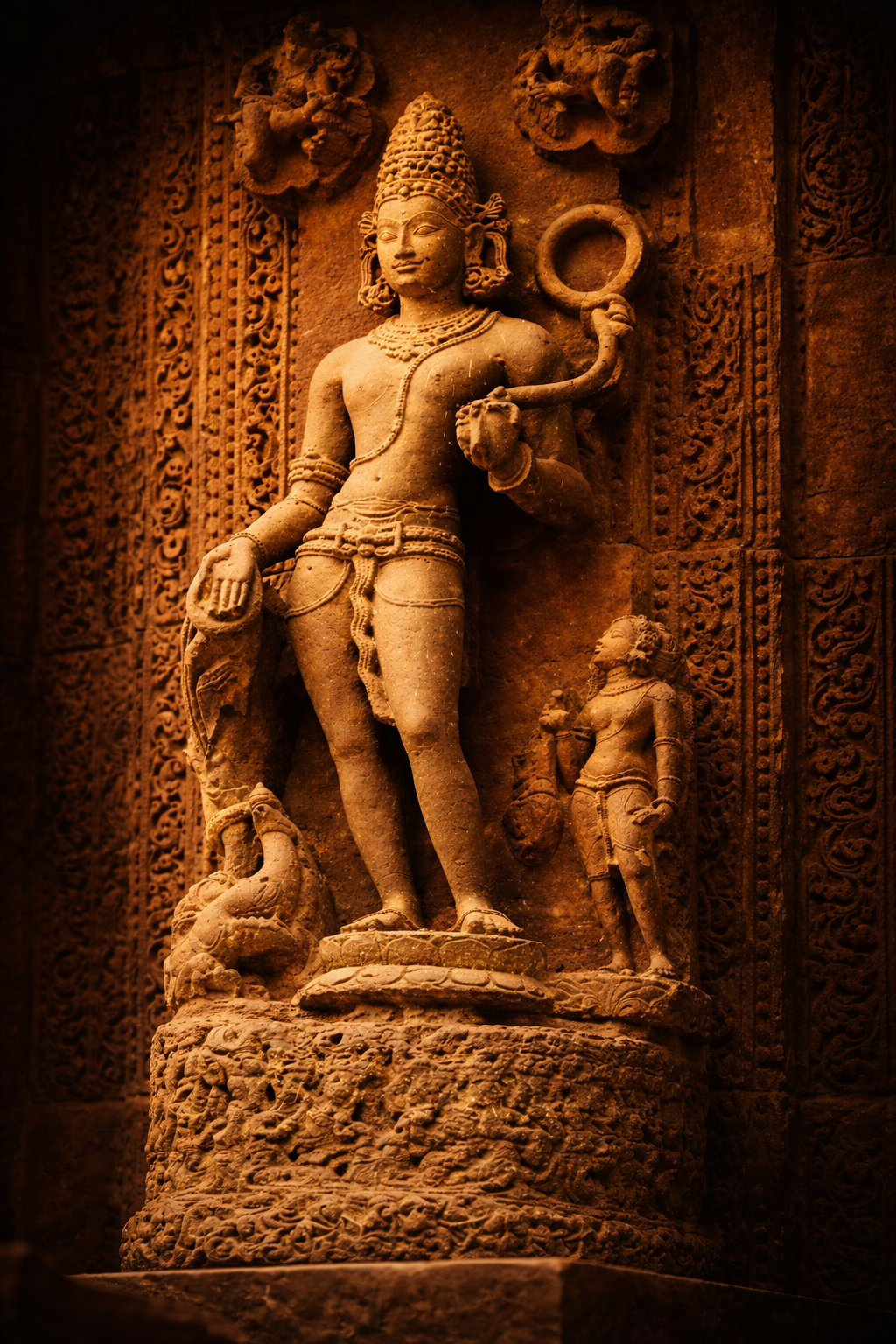
This essay is based on the analysis of the translation of the Rigveda in: Jamison, Stephanie W., and Joel P. Brereton. The Rigveda: The Earliest Religious Poetry of India. 3 vols., Oxford University Press, 2014. (ISBN: 978-0-19-937018-4).
Varuṇa in the Rigveda: Sovereignty, Ṛta, and What It Means to “Be”
Varuṇa occupies a distinctive place in the Rigveda as a divine figure of sovereignty and regulation. He appears as a central Āditya, strongly associated with vratá (“commandment, ordinance”), and he embodies an authority that holds together cosmic regularity, social normativity, and moral accountability. His sphere includes the governance of celestial rhythms, the ordering of waters and rain, and the supervision of human conduct—domains treated as mutually illuminating rather than separate.
1) Varuṇa’s profile: what sort of god is he?
In the Rigveda, Varuṇa is repeatedly presented as:
- A king of commandments: his vratá functions as a binding ordinance that structures the world’s reliability and the community’s moral expectations.
- An all-seeing sovereign: hymns speak of his spáśaḥ (“spies”), a political image used to express comprehensive oversight.
- A regulator of waters and prosperity: his command extends to waters, rainfall, and the channels through which life is sustained, aligning material flourishing with ordered governance.
This constellation—law-like ordinance, royal supervision, and life-giving waters—frames Varuṇa as a deity who renders order experienced and consequential.
2) Ṛta: “truth” as the structure of being
A central term for this order is ṛtá.
In Rigvedic usage, ṛtá carries the sense of “truth” and “order” at once: it expresses a stable structure that shapes how things are and how they relate. The hymns also imply that truth, especially when articulated in ritually effective speech, participates in sustaining that structure. Ṛta thus operates across cosmology, ethics, and ritual performance, functioning as a connective principle rather than a single “topic.”
Within this framework, Varuṇa stands as a primary divine agent of ṛtá’s intelligibility and force: order is represented as something that can be upheld, violated, and addressed.
3) Cosmic order as moral order, and moral order as cosmic order
Rigvedic portrayals often move from Varuṇa’s cosmic authority to moral consequence.
Images of a regulated sun-path, the patterned alternation of day and night, and the ordered movement of heavenly bodies appear as signs of governance. These same motifs then support moral inference: a world that holds its course under ordinance is one in which ordinance carries weight for human action. Cosmic regularity becomes a model for reliability in conduct, and moral deviation becomes legible within a universe structured by rule.
4) The famous “fetters”: bondage as a metaphysics of guilt
Varuṇa’s most emotionally charged symbol is the fetter (pāśa). Transgression is repeatedly imagined as binding—a tightening that expresses the moral gravity of disorder.
Hymns speak of being seized and bound, and they seek release through a structured petition: the loosening of bonds “above,” “below,” and “in the middle.” The imagery is layered and comprehensive, as if wrongdoing constricts life at multiple levels of existence.
The desired state is expressed through the idiom of Aditi (“guiltlessness, unboundedness”): a restored condition aligned with ordinance, in which bonds no longer hold and the subject stands again within the sphere of right relation.
5) Creator and redeemer: the same logic for cosmos and conscience
Rigvedic hymns also present Varuṇa as a power of cosmic articulation: splitting, stretching, measuring, and establishing space for the world’s functioning. This creative ordering connects naturally with his capacity to loosen what has been bound through fault.
The conceptual linkage is significant. The same semantic field that marks the world’s opening and structuring also supports the language of moral release. Creation, order, and forgiveness appear as related operations: an establishing of space, a restoration of right arrangement, and a re-entry into regulated existence.
6) Intimacy with the absolute: Varuṇa and the confessional voice
The hymns of Maṇḍala VII (especially the Varuṇa sequence associated with Vasiṣṭha) are notable for their intimate, confessional register. The relationship between poet and deity moves through distance, appeal, acknowledgment of fault, and a renewed seeking of favor.
Wrongdoing is described in human terms—impairment, thoughtlessness, the pressures of circumstance—and the hymns explore a tension between human vulnerability and a divine order that sees fully. The result is a distinctive Rigvedic psychology: moral accountability experienced as exposure to an all-encompassing ordinance.
7) “Right here”: Varuṇa within the human world
Alongside royal distance and cosmic scale, the Rigveda also entertains a theme of radical proximity. Varuṇa’s power is depicted as present within lived reality, even within the embodied sphere, so that ordinance is felt internally as well as observed externally.
In this mode, Varuṇa’s sovereignty becomes experiential: oversight is not only a cosmic attribute but also a condition that can be sensed as nearness—an immediacy of order that touches the human domain from within.
Conclusion: What does Varuṇa “stand for” in the Rigveda?
Varuṇa stands for sovereignty as the binding force of ṛtá: an authority that orders the cosmos, legislates communal and moral life, supervises conduct, and expresses moral failure through the imagery of constriction and fetters—while also holding the power of loosening, restoration, and return to guiltlessness.
He represents a Rigvedic vision in which reality has dependable structure, that structure carries normative force, and life unfolds within a field where order is both cosmic and ethical.
Share This, Choose Your Platform!
Follow & Contact Us

We reestablish the Mithraic traditions. Subscribe now and stay in touch.